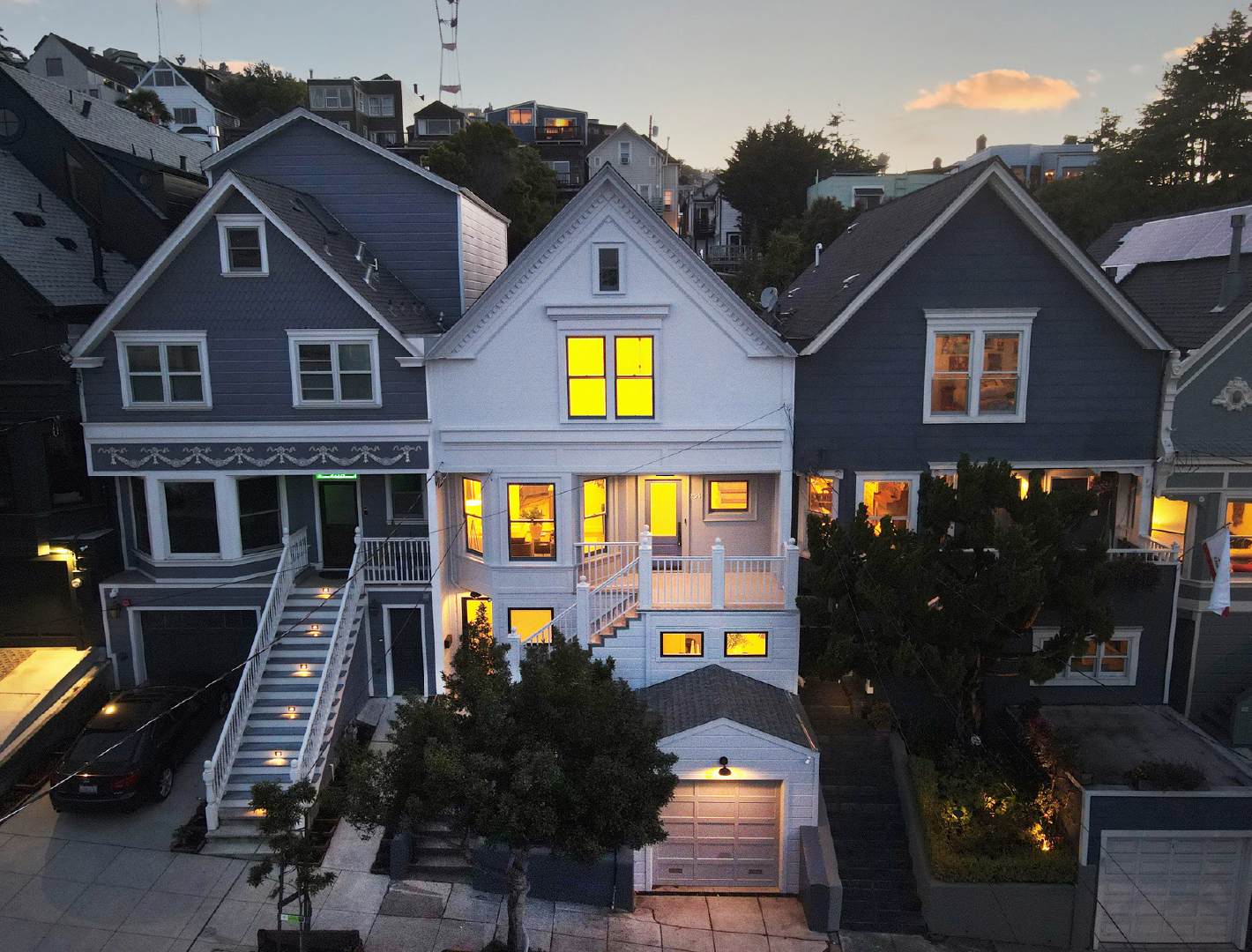
Truly contemporary homes are among the rarest properties in San Francisco — and the most quietly extraordinary.
A contemporary Victorian: a historic facade preserved, everything behind it rebuilt.
Strictly contemporary architecture in San Francisco is rare — new-build, ground-up single-family homes are almost nonexistent. The city’s development policies and lengthy approval processes make it nearly impossible to build new homes unless they’re multi-unit buildings.
But what is more common, and more exciting, is the radically reimagined home: a property that retains a single original wall or just the front facade while everything else is rebuilt from the ground up. These aren’t just remodels — they’re full-scale reinventions, blending cutting-edge materials, high-performance systems, and sophisticated design into something that stands apart.
Make no mistake — these homes sit at the top of the market for their neighborhoods. They represent the highest end of recent sales comps, commanding premium prices thanks to their extensive upgrades, design pedigree, and sheer rarity. Whether it’s a sleek new build or a transformed Victorian, these homes redefine contemporary living in San Francisco.
One of the most captivating versions of the contemporary home is the Contemporary Victorian — where a historic Victorian or Edwardian is transformed with a sleek, sophisticated aesthetic. These homes often retain their classic facade but embrace a cool, modern color palette, bold contrast elements, and ultra-clean interiors. Think matte black or deep charcoal exteriors paired with light, airy interiors that highlight the best of both old and new.
What defines these homes isn’t just their sleek aesthetic — it’s the materials and engineering behind them. Many feature:
Here’s the distinction that matters most. Filling a home with luxury brands is one thing — but introducing them artfully is where true design lives. That’s the X factor: the balance of scale, finishes, sensibility, light, and views, all in conversation with one another.
“You can put a La Cornue range in the kitchen — but unless the stone, the lighting, and the millwork are speaking the same language, it’s just an expensive object in an ordinary room.”
More often than not, you can tell the difference between a luxury home, a merely well-built home, and a showy, cynical flip by the details that don’t photograph well: the hardware, the baseboards, the millwork, the paint finishes, how exacting the lines are, the choice of materials. It shows in the systems, too — radiant heat, properly zoned air conditioning, double-pane windows, skylights placed for architecture rather than as an afterthought.
The real thing looks composed. The imitation looks assembled — thrown together to maximize a resale number. Once you know what to look for, the two are never hard to tell apart.
Not every modernized home is created equal. The most noteworthy, high-end contemporary homes stand out because they weren’t just remodeled — they were intentionally designed. Whether by an architect, an interior designer, or a top-shelf builder, these homes have a level of thoughtfulness and execution that sets them apart.
While not all updated homes will have every feature below, they’ll likely include at least some of these signature elements:
Wide-plank white oak floors in a lighter natural finish, paired with high-end stone or quartz countertops for a crisp, refined aesthetic.
European cabinetry from houses like Boffi or Poggenpohl, or fully custom millwork — built to the room rather than ordered to fit it.
Recessed, indirect, and ambient lighting on Lutron-based systems — HomeWorks or RadioRA — allowing precise, personalized control.
Luxurious paints such as Farrow & Ball, with an emphasis on matte and low-sheen finishes over anything glossy.
Massive Fleetwood or NanaWall glass panels connecting indoor and outdoor space, and solid white oak doors throughout.
Nest thermostats and detectors recessed flush into the ceiling during drywalling, so technology blends in rather than protrudes.
Designer hardware and finishes from top-tier brands, often in bespoke colorways — the kind featured in Dwell or Architectural Digest.
Appliances you never knew existed — often multiple sets — built for serious culinary use, or at least designed to look the part.
Heated floors, stone and glass, floating vanities, and Japanese-style bidet toilets. Some are spa-like retreats; all are spectacular.
At least one standout detail that quietly shows off the workmanship — a floating staircase, an artful built-in, a near-invisible pivot door.
A second kitchen, a secondary laundry area, or an entire additional unit (ADU) that adds flexibility and function.
Vast open spans across multiple floors, made possible by structural engineering, creating a real sense of volume and grandeur.
Polished concrete floors, epoxy finishes, and — in ultra-luxury homes — even a spinning car turntable.
Cat 5/6 cabling, ceiling speakers, server racks, and automation controlling lighting, climate, security, and audio from an iPad.
In multi-level homes, a residential elevator — because convenience and luxury go hand in hand.
Plans, permits, and engineering reports that document the home's transformation and reinforce its pedigree.

The most exacting homes carry a paper trail to match the build. Super-high-end projects will often come with a full booklet of permits, instruction manuals, and other diligence materials. Physical copies of the plans should usually be available as well — along with job cards, contractor and subcontractor contact information, and the records that let a future owner understand exactly what was done, and by whom.
Here’s a small curiosity worth keeping in mind: you’ll often see these homes presented in the MLS with the lights off. It’s a strange habit — these are houses defined in large part by their lighting design, photographed as if that layer didn’t exist. When you tour one in person, ask to see it lit. The difference is the whole point.
These homes aren’t just contemporary — they’re meticulously designed, radically updated, and built for the way people live today.