
Sunset/Parkside/Golden Gate Heights
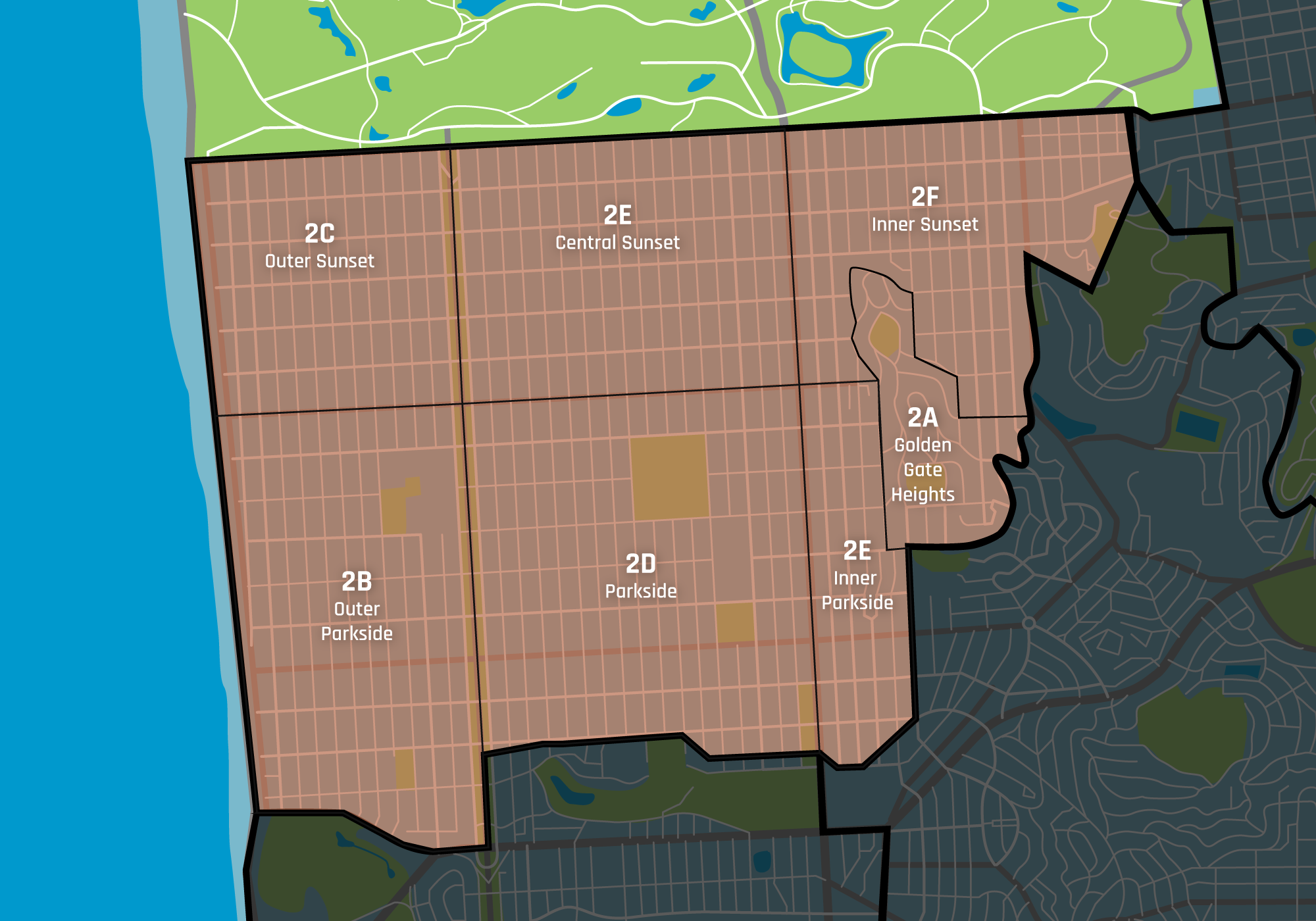
The Sunset is defined by its wide streets, consistent residential character, and close relationship with Golden Gate Park, Ocean Beach, and the San Francisco Zoo. Commercial corridors along Irving, Judah, Noriega, and Taraval provide neighborhood restaurants, cafés, and local businesses, while the N Judah and L Taraval Muni lines connect residents to downtown and the rest of the city. It’s a part of San Francisco where routines tend to last, long-term ownership is common, and the combination of parks, transit, and the Pacific coastline shapes daily life.
Parkside shares much of the Sunset’s residential character but offers a quieter pace and a greater concentration of detached homes. Broad avenues, well-maintained streets, and convenient access to Ocean Beach, Stern Grove, and neighborhood shopping create an environment that appeals to buyers looking for space, stability, and a strong sense of community.
Golden Gate Heights rises above both neighborhoods, trading the traditional street grid for winding hillside roads, panoramic views, and a greater sense of separation from the city below. Homes often take advantage of the terrain with expansive outlooks toward the Pacific Ocean or downtown skyline, creating one of San Francisco’s most distinctive residential settings while remaining closely connected to the surrounding West Side.
A couple of Saturdays ago, I met some friends at Hook Fish — which already tells you something about this part of the Sunset. The blocks are wider here, the buildings lower, and the pace slower. You’re not surrounded by ground-floor retail or constant foot traffic; most homes sit above garages with modest setbacks, giving the streets a more open, residential feel. After lunch we crossed over toward the Great Highway — now Sunset Dunes — where the city opens up and the edge of San Francisco becomes unmistakable. On most weekends, you’ll see surfers coming and going, boards under their arms, wetsuits half-zipped, moving between the water and their cars as casually as someone running errands.
That proximity to the ocean shapes everything, from the light and weather to how homes are built and maintained. As we walked back through the neighborhood, the architecture stayed largely consistent: stucco façades, tunnel-entry layouts, practical floor plans, and rows of homes built for function rather than ornament. You see fewer dramatic remodels here than in neighborhoods like Noe Valley or the Mission, but in exchange you often get more square footage, more usable space, and a quieter rhythm of daily life. Many of the houses reflect long-term ownership — places that have been cared for, updated selectively, and lived in across generations rather than constantly turned over.
The people you pass on a walk like this tend to fall into a familiar mix: longtime owners, younger families trading centrality for space, surfers and beach regulars who organize their days around tide and wind, and renters connected to nearby universities and medical centers. That blend shapes everything from school demand to renovation trends and pricing behavior. The Sunset isn’t flashy, but it’s deeply livable — and once you understand how its geography, housing stock, and community fit together, the market here starts to make a lot more sense.
For a deeper, block-by-block look at how the Sunset actually works — from Inner to Outer, housing types to pricing patterns — the full Sunset District Survey dives into the details.
Closer to the ocean, more fog, more space
Balanced access to both park and commercial corridors
Closer to Golden Gate Park and transit, slightly more active
Elevated, quieter, with views and a more tucked-away feel
Residential, steady, and close to the coast
Quiet interior blocks with a strong neighborhood rhythm
Closer to transit and commercial edges, with easy access across the city
The layers that define the district
In the Sunset, what feels uniform at first starts to reveal itself over time. The grid creates consistency, but within it, each block has its own light, exposure, and rhythm. Buyers who spend time here begin to notice how much those small differences shape daily life.
The Texture of Daily Life
Restaurants, groceries, and the daily rhythm of the neighborhood
Quieter, more local—where routines settle in
Fog, surf, and open space at the edge of the city
A backyard that stretches for miles through the neighborhood
Places That Shape It
And Who Feels at Home Here
The Sunset is defined by its wide streets, consistent residential character, and close relationship with Golden Gate Park, Ocean Beach, and the San Francisco Zoo. Commercial corridors along Irving, Judah, Noriega, and Taraval provide neighborhood restaurants, cafés, and local businesses, while the N Judah and L Taraval Muni lines connect residents to downtown and the rest of the city. It’s a part of San Francisco where routines tend to last, long-term ownership is common, and the combination of parks, transit, and the Pacific coastline shapes daily life.
Parkside shares much of the Sunset’s residential character but offers a quieter pace and a greater concentration of detached homes. Broad avenues, well-maintained streets, and convenient access to Ocean Beach, Stern Grove, and neighborhood shopping create an environment that appeals to buyers looking for space, stability, and a strong sense of community.
Golden Gate Heights rises above both neighborhoods, trading the traditional street grid for winding hillside roads, panoramic views, and a greater sense of separation from the city below. Homes often take advantage of the terrain with expansive outlooks toward the Pacific Ocean or downtown skyline, creating one of San Francisco’s most distinctive residential settings while remaining closely connected to the surrounding West Side.
A couple of Saturdays ago, I met some friends at Hook Fish — which already tells you something about this part of the Sunset. The blocks are wider here, the buildings lower, and the pace slower. You’re not surrounded by ground-floor retail or constant foot traffic; most homes sit above garages with modest setbacks, giving the streets a more open, residential feel. After lunch we crossed over toward the Great Highway — now Sunset Dunes — where the city opens up and the edge of San Francisco becomes unmistakable. On most weekends, you’ll see surfers coming and going, boards under their arms, wetsuits half-zipped, moving between the water and their cars as casually as someone running errands.
That proximity to the ocean shapes everything, from the light and weather to how homes are built and maintained. As we walked back through the neighborhood, the architecture stayed largely consistent: stucco façades, tunnel-entry layouts, practical floor plans, and rows of homes built for function rather than ornament. You see fewer dramatic remodels here than in neighborhoods like Noe Valley or the Mission, but in exchange you often get more square footage, more usable space, and a quieter rhythm of daily life. Many of the houses reflect long-term ownership — places that have been cared for, updated selectively, and lived in across generations rather than constantly turned over.
The people you pass on a walk like this tend to fall into a familiar mix: longtime owners, younger families trading centrality for space, surfers and beach regulars who organize their days around tide and wind, and renters connected to nearby universities and medical centers. That blend shapes everything from school demand to renovation trends and pricing behavior. The Sunset isn’t flashy, but it’s deeply livable — and once you understand how its geography, housing stock, and community fit together, the market here starts to make a lot more sense.
For a deeper, block-by-block look at how the Sunset actually works — from Inner to Outer, housing types to pricing patterns — the full Sunset District Survey dives into the details.
Closer to the ocean, more fog, more space
Balanced access to both park and commercial corridors
Closer to Golden Gate Park and transit, slightly more active
Elevated, quieter, with views and a more tucked-away feel
Residential, steady, and close to the coast
Quiet interior blocks with a strong neighborhood rhythm
Closer to transit and commercial edges, with easy access across the city
The layers that define the district
In the Sunset, what feels uniform at first starts to reveal itself over time. The grid creates consistency, but within it, each block has its own light, exposure, and rhythm. Buyers who spend time here begin to notice how much those small differences shape daily life.
The Texture of Daily Life
Restaurants, groceries, and the daily rhythm of the neighborhood
Quieter, more local—where routines settle in
Fog, surf, and open space at the edge of the city
A backyard that stretches for miles through the neighborhood
Places That Shape It
And Who Feels at Home Here