
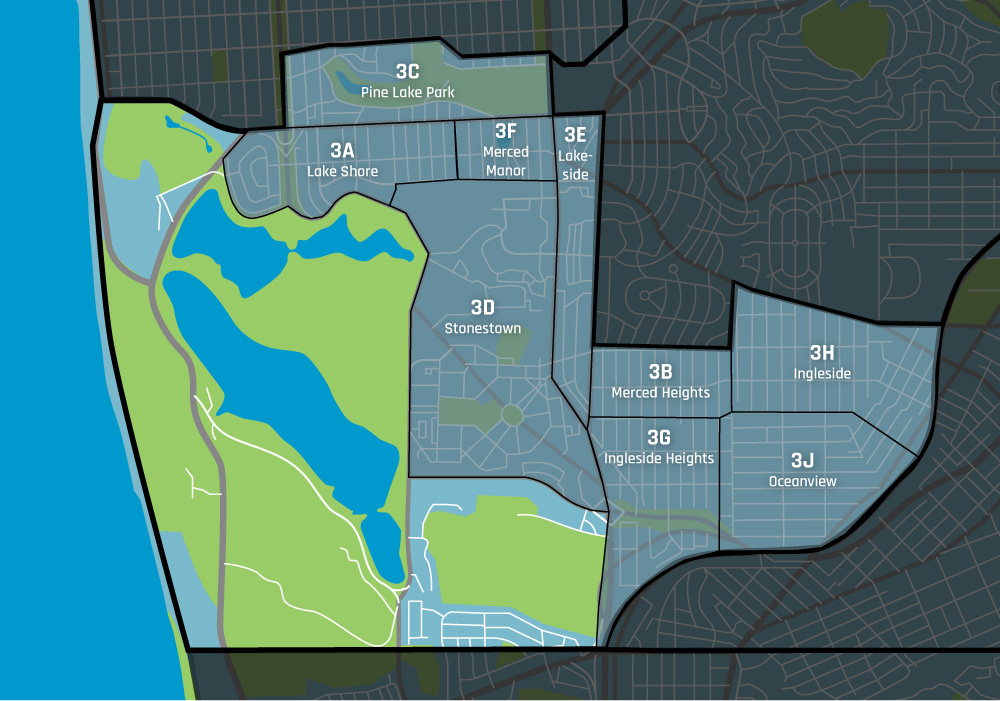
Lake Merced/Stonestown/Ingleside/Oceanview
Southwest San Francisco moves differently. The grid loosens, the hills create distance between blocks, and the rhythm of daily life shifts toward something steadier. It’s less about density and more about continuity—neighborhoods that feel lived in, not passed through. For many buyers, this part of the city offers a kind of clarity: more space, more predictability, and a pace that supports how people actually want to live over time.
Stonestown has long been an anchor here. Even as it’s evolved, it remains where daily life converges—groceries, quick meals, familiar routines. From there, the neighborhood branches out depending on the day. Ocean Avenue carries a more local, unfiltered rhythm, while nearby residential streets quickly become quieter and more settled.
San Francisco State adds a different kind of energy at the edge of the district. Around the campus, there’s a noticeable shift—more movement, more turnover, a steady flow of students and transit—but it tapers off quickly as you move back into the surrounding streets.
What defines Southwest isn’t any single destination—it’s the sense of space. The streets are quieter, the blocks feel more separated, and the overall pace settles into something more consistent. Nothing is rushed, and nothing is competing for attention in the same way.
Up near Mount Davidson, the fog tends to settle in differently—slower, heavier—and it subtly changes the feel of the area. Light, wind, and elevation all play a role here, and those differences become more noticeable over time.
That’s really the character of this part of the city. Instead of everything happening at once, the details reveal themselves gradually—how one block feels more open than the next, how certain streets stay quiet throughout the day, and how routines take hold and remain steady.
It’s not built around being the center of activity. And for many buyers, that’s exactly what makes it work.
Along Lake Merced, more space, softer edges, and a quieter feel
Tucked between water and homes, calm and a bit removed
Close to transit and retail, with a practical, everyday rhythm
Residential and steady, with a more traditional neighborhood feel
A central hub with daily essentials and constant movement
Elevated in places, with views and a slightly more open feel
Quiet blocks with a strong sense of neighborhood continuity
More connected and active, with access to transit and local corridors
At the edge of the city, with space, variety, and long-term potential
Areas that shape the Southwest
In Southwest, the differences show up gradually. Streets feel quieter, blocks feel more defined, and daily life settles into a rhythm that doesn’t shift much week to week. The presence of San Francisco State and nearby transit brings moments of activity, but it fades quickly into a more residential pace. Over time, what stands out isn’t any single feature—it’s the consistency.
What You Notice Over Time
Everyday essentials, evolving retail, and a long-standing anchor
Transit, local businesses, and a more unfiltered city rhythm
A steady pulse of activity that adds movement at the edge
Open space, water, and a place to step away from the city
Where Daily Life Happens
And Who Feels at Home Here
Southwest San Francisco moves differently. The grid loosens, the hills create distance between blocks, and the rhythm of daily life shifts toward something steadier. It’s less about density and more about continuity—neighborhoods that feel lived in, not passed through. For many buyers, this part of the city offers a kind of clarity: more space, more predictability, and a pace that supports how people actually want to live over time.
Stonestown has long been an anchor here. Even as it’s evolved, it remains where daily life converges—groceries, quick meals, familiar routines. From there, the neighborhood branches out depending on the day. West Portal offers something more polished and walkable, while Ocean Avenue carries a more local, unfiltered rhythm.
San Francisco State adds a different kind of energy at the edge of the district. Around the campus, there’s a noticeable shift—more movement, more turnover, a steady flow of students and transit—but it tapers off quickly as you move back into the surrounding streets.
What defines Southwest isn’t any single destination—it’s the sense of space. The streets are quieter, the blocks feel more separated, and the overall pace settles into something more consistent. Nothing is rushed, and nothing is competing for attention in the same way.
Up near Mount Davidson, the fog tends to settle in differently—slower, heavier—and it subtly changes the feel of the area. Light, wind, and elevation all play a role here, and those differences become more noticeable over time.
That’s really the character of this part of the city. Instead of everything happening at once, the details reveal themselves gradually—how one block feels more open than the next, how certain streets stay quiet throughout the day, how routines take hold and remain steady.
It’s not built around being the center of activity. And for many buyers, that’s exactly what makes it work.
Along Lake Merced, more space, softer edges, and a quieter feel
Tucked between water and homes, calm and a bit removed
Close to transit and retail, with a practical, everyday rhythm
Residential and steady, with a more traditional neighborhood feel
A central hub with daily essentials and constant movement
Elevated in places, with views and a slightly more open feel
Quiet blocks with a strong sense of neighborhood continuity
More connected and active, with access to transit and local corridors
At the edge of the city, with space, variety, and long-term potential
Areas that shape the Southwest
In Southwest, the differences show up gradually. Streets feel quieter, blocks feel more defined, and daily life settles into a rhythm that doesn’t shift much week to week. The presence of San Francisco State and nearby transit brings moments of activity, but it fades quickly into a more residential pace. Over time, what stands out isn’t any single feature—it’s the consistency.
What You Notice Over Time
Everyday essentials, evolving retail, and a long-standing anchor
Transit, local businesses, and a more unfiltered city rhythm
A steady pulse of activity that adds movement at the edge
Open space, water, and a place to step away from the city
Where Daily Life Happens
And Who Feels at Home Here