TEAM K.HO · SF DISTRICT SURVEY · 2026

District 2

The Sunset, Parkside, & Golden Gate Heights

DISTRICT 5J

4,988 house sales · April 2015 – August 21, 2026
$1.90M
Median Sale
2026 YTD
+15%
Year Over Year
Same Window
$1,191
Median
Per Sqft
134.2%
Median Sale
To List Price
12
Median Days
On Market
Start with the shape of it

The most legible neighborhood in the City

Alphabetical streets running east to west, numbered avenues running north to south, the ocean on one edge and Golden Gate Park on the other. Seven subdistricts on one grid — and, in 2026, remarkably little daylight between them.
OCEAN BEACH · SUNSET DUNES GOLDEN GATE PARK 2C · Outer Sunset $1,870,000 2E · Central Sunset $2,003,888 2F · Inner Sunset $2,339,000 2A · Golden Gate Hts $2,300,000 2B · Outer Parkside $1,712,500 2D · Parkside $1,930,000 2G · Inner Parkside $2,000,000 LINCOLN JUDAH NORIEGA QUINTARA TARAVAL WAWONA SLOAT 48TH 40TH 33RD 25TH 19TH 12TH 2ND MEDIAN SINGLE-FAMILY SALE PRICE, JAN 1 – AUG 21, 2026 · SF MLS · SUBDISTRICT LINES SCHEMATIC
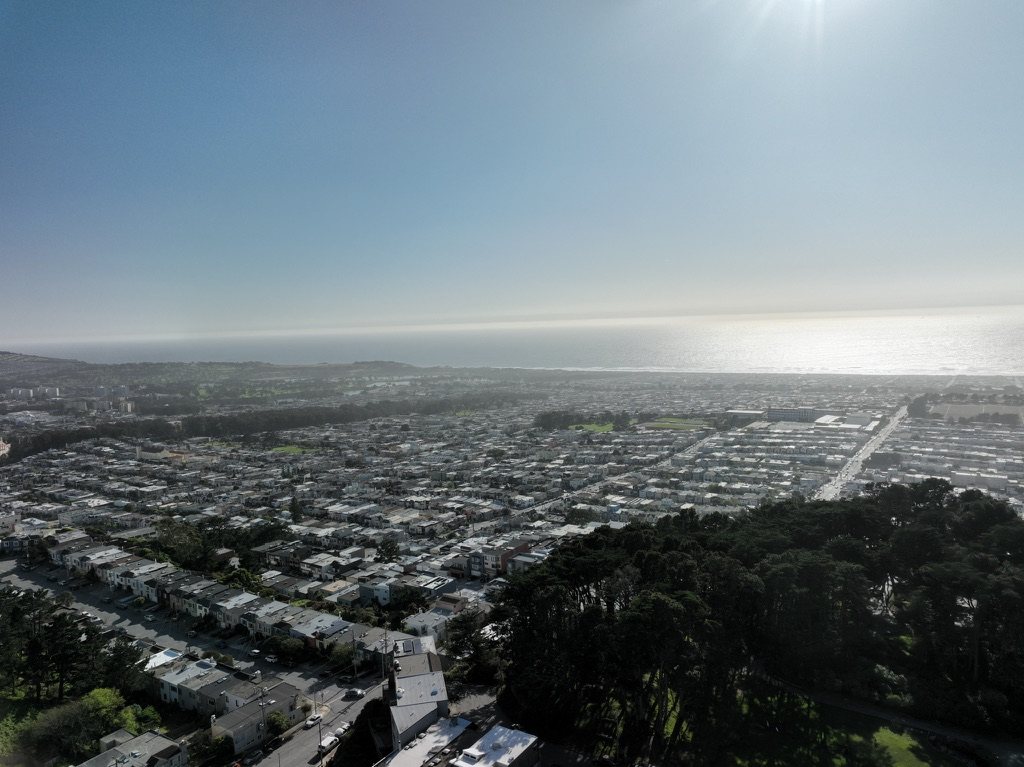
View across the northern edge of San Francisco District 2 near Golden Gate Park.
North edge. The park canopy gives way to the grid. Homes on the 1200–1500 blocks see the most of it.
West-facing view across the Sunset District toward Ocean Beach.
West. Rows running straight to the water. The fog rep is real; it just arrives later than it used to.
South-facing view across Parkside toward Sloat Boulevard and the San Francisco Zoo.
South. Toward Sloat and the zoo, where the grid loosens and the houses start to surprise you.
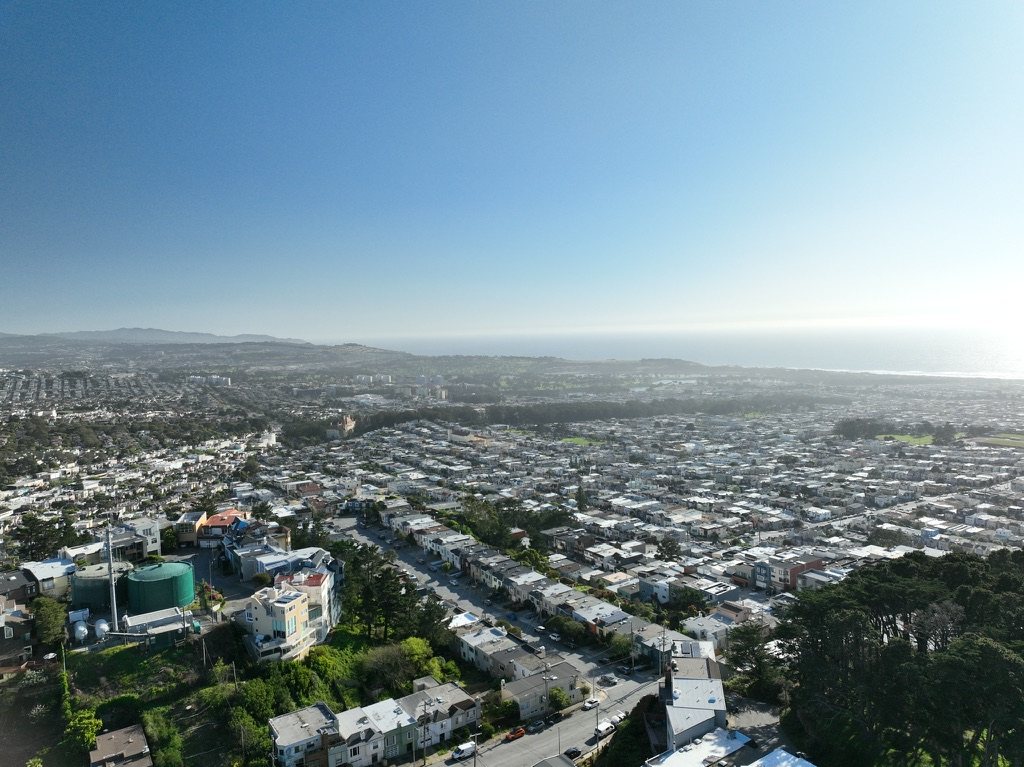
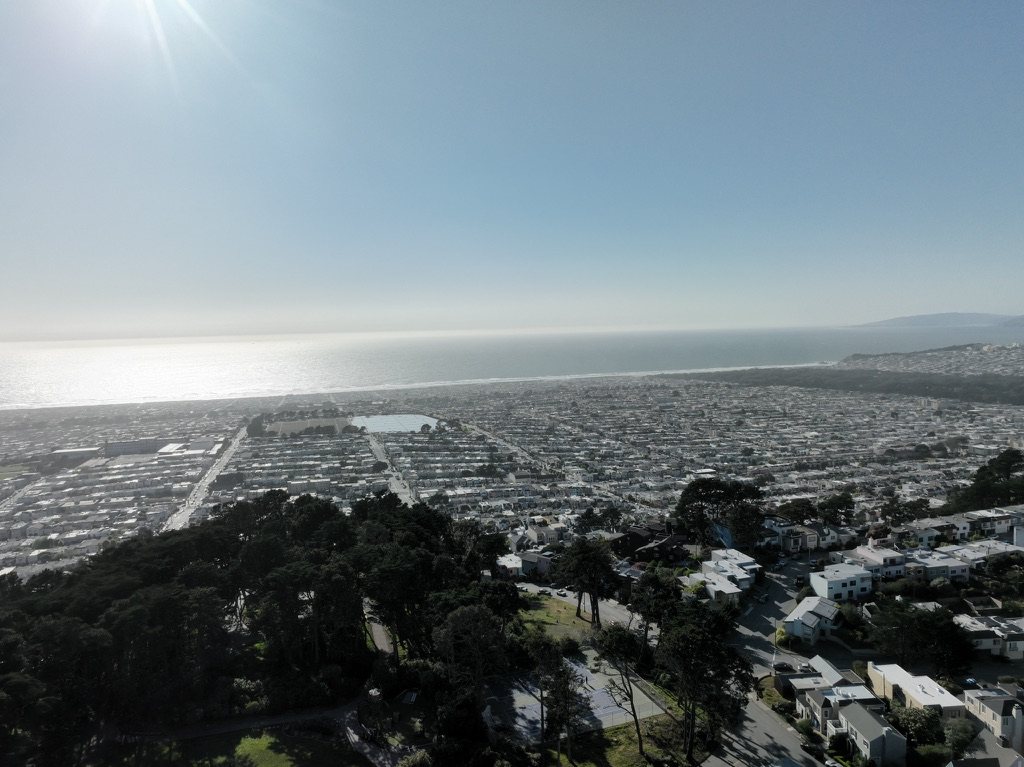
Elevated view from Golden Gate Heights across San Francisco District 2.
Up top. Golden Gate Heights — curved streets, deep irregular lots, and the district’s biggest views.
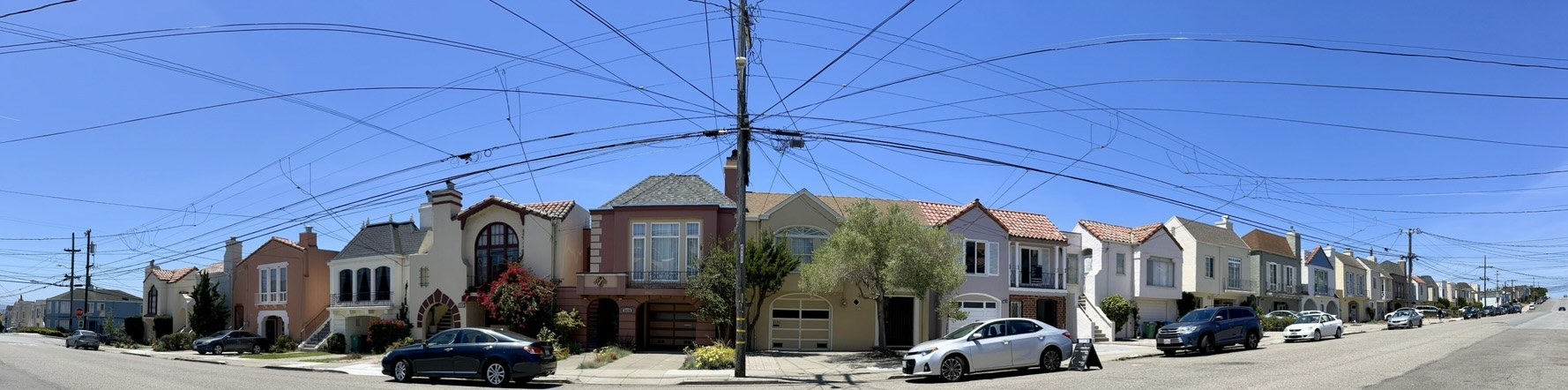
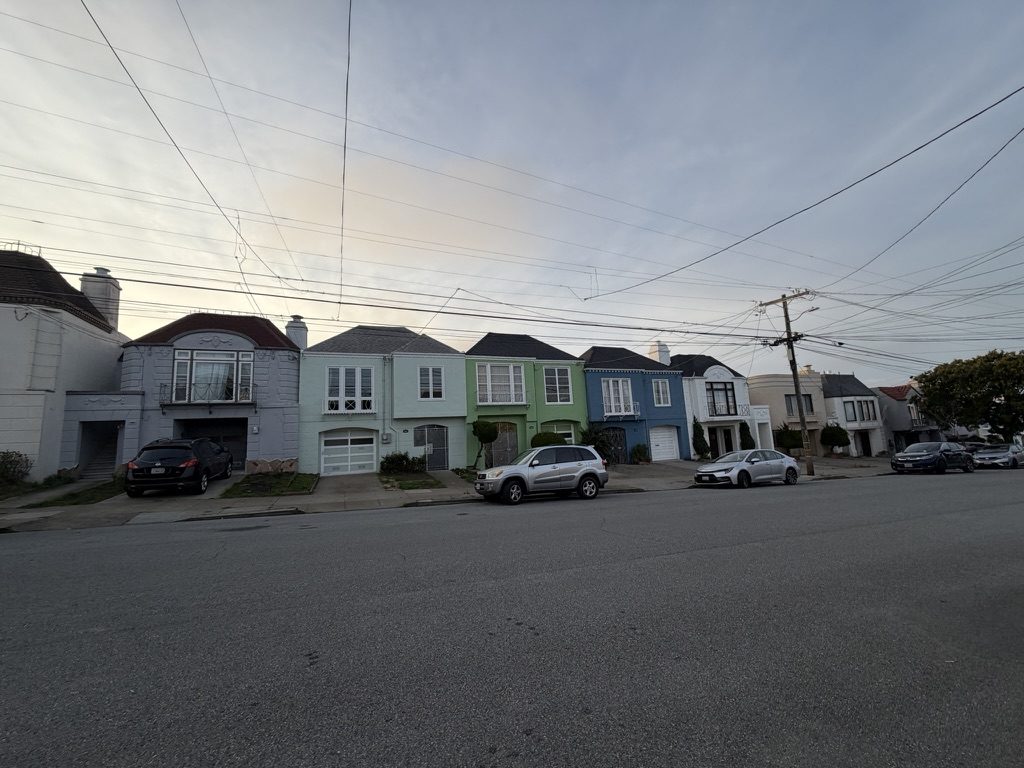
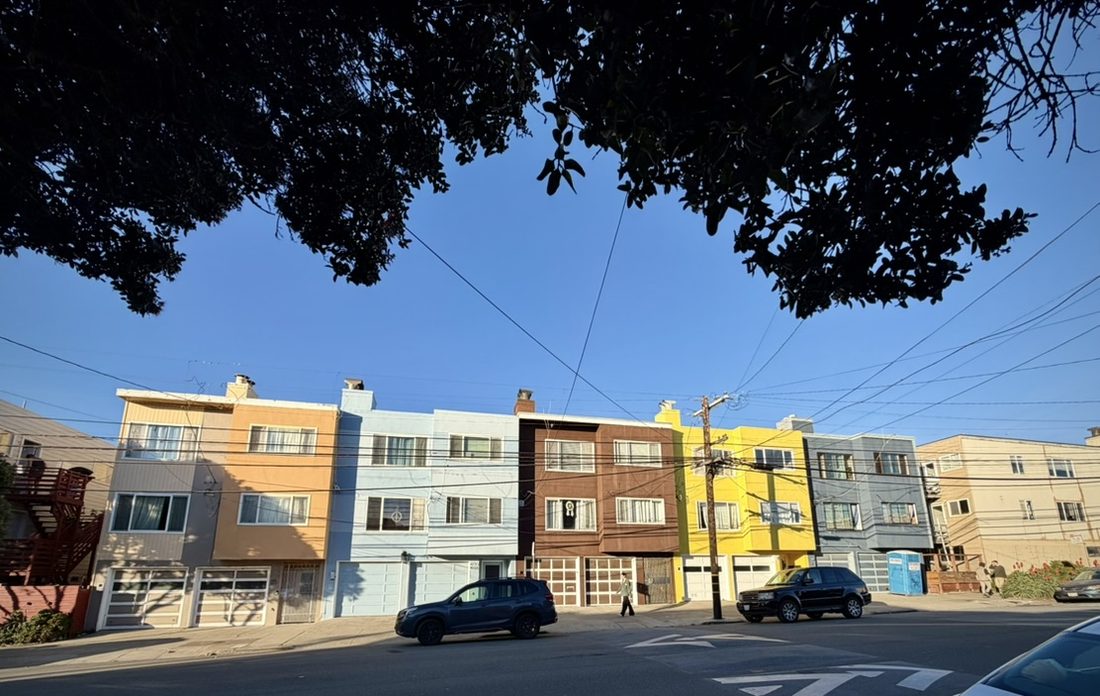
A row of homes in San Francisco District 2 illustrating the neighborhood's variations on a common residential floor plan.
One block, eight houses, one floor plan · Median year built in District 2 is 1940
The short version

Eleven years, 4,988 houses

The short version of it

Eleven years, 4,988 house

District 2 has changed more than any other part of the City since we published the first District Survey in 2016 — not because the houses changed (they mostly haven’t), but because everything around them did.

Start with who lives here. The families who bought after the war, and the children they raised in these houses, have been handing the neighborhood over — to Gen Z and the generations right behind them buying their first house, and to flippers, who are buying more of these houses than they used to and expanding them into four and five bedrooms by digging out the space behind the garage. The finish level has come up, though you’ll spot the buy-three-Thermador-pieces-get-the-fourth-free package a lot. You can see all of it on foot. More scaffolding, more third stories, more black window frames, more houses that were a junior five in 2016 and are something else entirely now.

Then look at the frame around it. The commercial strips thickened and pushed west, past 40th Avenue, into blocks that had no reason to draw an operator ten years ago. Two miles of the Great Highway became a park. And the zoning that held this district still for twenty years changed in the space of a single year.

All of which makes District 2 an unusually interesting place to be right now — and an unusually interesting one to be part of. Especially if you’re the sort of person who likes a cooler, foggier climate, countered by sunsets that are genuinely epic.

Single-Family Sales, SF MLS
Measure 2015 (Apr–Dec) 2026 (Thru Aug 21)
Median sale price $1,199,000 $1,902,500
Median price per sqft $756 $1,191
Median sale-to-list 122.0% 134.2%
Sold over list 91.8% 90.2%
Median days on market 15 12
Sales at or above $2M 2.6% 45.1%
Sales under $1.5M 83.9% 10.9%

That’s +59% on price and +58% on price per sqft in eleven years, with the entire recent leg — +15% year over year — landing in the last twelve months. In 2015, five out of six houses out here traded under $1.5M. In 2026, one in nine does.

This is not a rate story. The 30-year fixed sat at 6.65% the week of August 20, essentially flat against a year ago. It's an inventory-and-income story — and District 2 is where the City's demand is landing hardest.

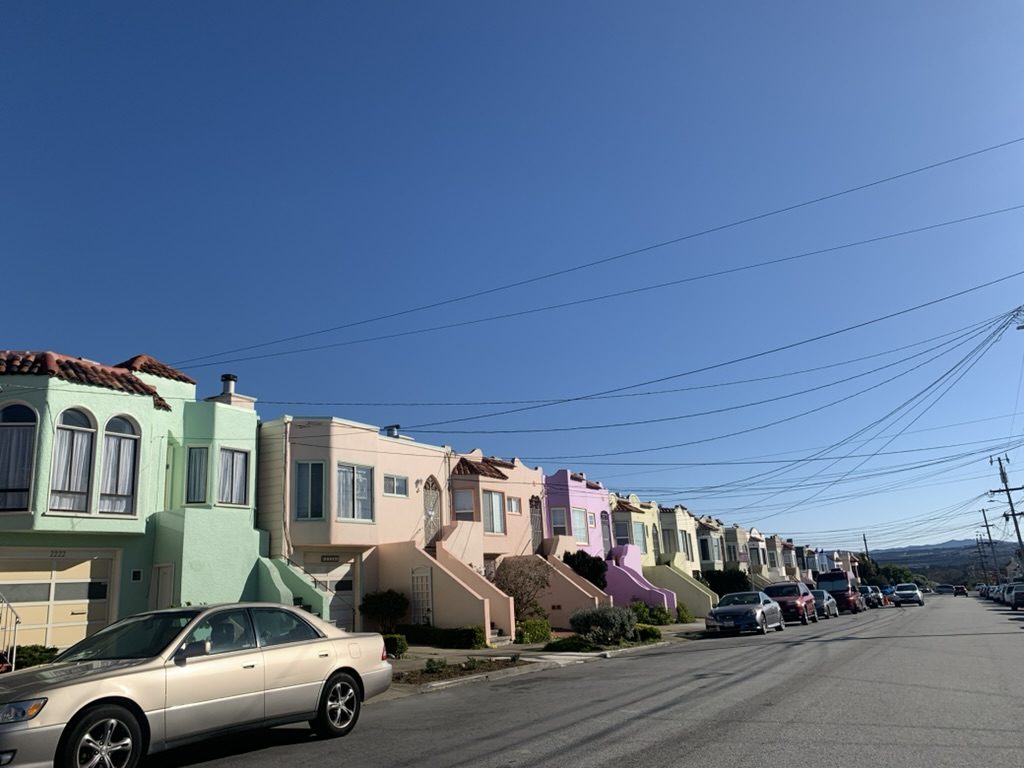
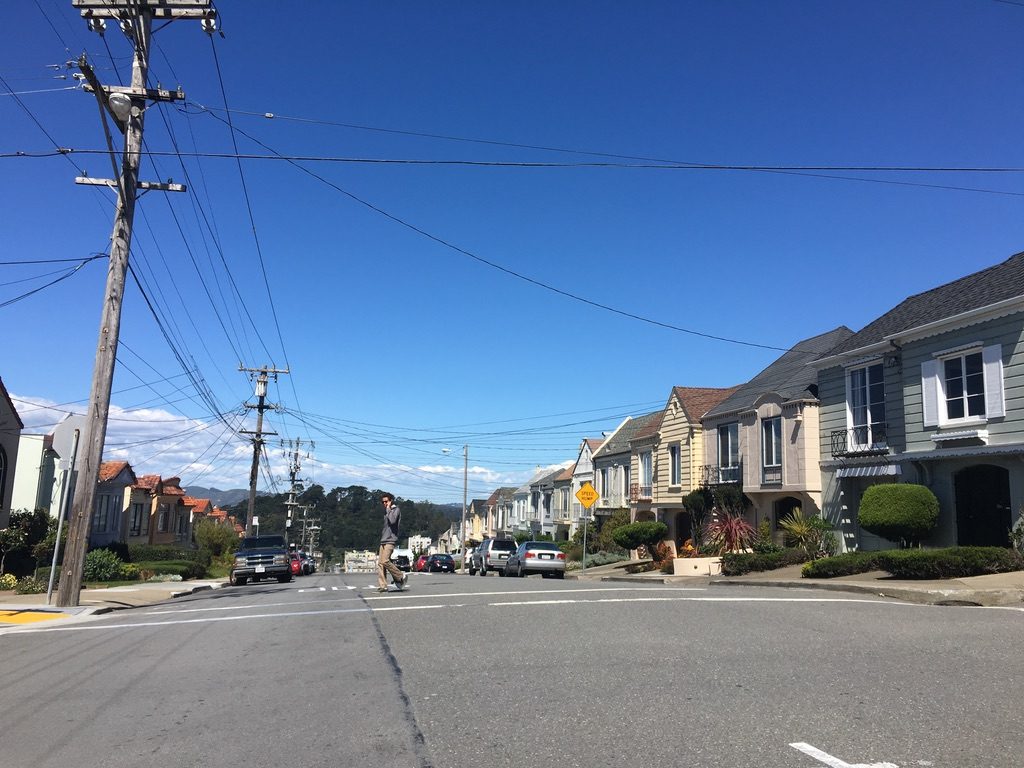
Rows of homes on a residential street in San Francisco's Sunset District.
Why people come. A house with a garage, a yard and no HOA dues, for what a two-bedroom Victorian condominium costs closer in. That trade is still the whole pitch — the difference is how many people are now making it.

Why now

  • The generational handoff. The people who bought after the war and raised their children here are still transitioning out — 25.6% of 2026 sales came from a trust, probate or estate, up from under 4% a decade ago. That’s the supply engine, and it’s still running
  • Access. Straight shot to the Peninsula; the N Judah and L Taraval both terminate out here
  • The oceanfront changed. Two miles of the Great Highway are now a park

The room behind the garage, in three acts

The downstairs space is the most underrated thing in this district, and what people use it for has changed twice in forty years.

  • Then: a workshop, a knotty-pine rumpus room, or just plain unfinished space
  • The 80s and 90s: suddenly a rental opportunity — an SF State or UCSF student in the in-law behind the garage, and rent that offset the taxes. That’s a big part of why buyers came out here at all
  • Now: somewhere for grandparents to stay, or where a flipper adds a primary en suite bedroom or two


Same square footage the whole time. Three completely different reasons to want it.

And about the fog

Affectionately, Karl. Technically, coastal fog — and the microclimates out here are the product of a heat and moisture differential: warm inland land on one side, the mass of cooler ocean water sitting right off the beach on the other. Which is why two blocks apart can be a genuinely different climate, and why touring at 11 a.m. in October teaches you almost nothing about July.

The rep was always that it’s foggy out here. That rep has started to change, and the people who noticed first bought here while you were busy looking in the eastern half of the City.

Which is most of the story of the last decade: the median District 2 house is up 59% since 2015, and some blocks have done considerably better than that. Not because the houses got better. Because the weather did, and because the rest of the City got expensive.

The geography still matters, though. The district is flat through most of the Avenues, then tips into a gentle slope toward Ocean Beach once you pass Sunset Boulevard. And Karl the Fog has not surrendered — at the beach in July he can settle in for two weeks straight and as thick as you can imagine.

2026, subdistrict by subdistrict

Seven neighborhoods, one grid

The 266 single-family homes that closed between January 1 and August 21, 2026. Boundaries are ours, drawn off street and avenue position — the MLS reports District 2 as a single area.

District 2F
Inner Sunset
$2,339,000
Sales 20
Per sqft $1,326
% of list 138.0%
Days on mkt 11
District 2A
Golden Gate Heights
$2,300,000
Sales 25
Per sqft $1,144
% of list 133.0%
Days on mkt 13
District 2E
Central Sunset
$2,003,888
Sales 49
Per sqft $1,211
% of list 135.4%
Days on mkt 13
District 2G
Inner Parkside
$2,000,000
Sales 4
Per sqft $1,373
% of list 125.1%
Days on mkt 20
District 2D
Parkside
$1,930,000
Sales 25
Per sqft $1,109
% of list 136.2%
Days on mkt 12
District 2C
Outer Sunset
$1,870,000
Sales 63
Per sqft $1,153
% of list 135.4%
Days on mkt 11
District 2B
Outer Parkside
$1,712,500
Sales 30
Per sqft $1,154
% of list 126.2%
Days on mkt 12

What jumps out

  • The spread has collapsed. In 2015 the gap between the priciest and cheapest subdistrict was $435,000 — 42% of the cheapest median. Today it’s $626,500, but only 37%. A buyer who once had a real budget choice between the Inner Sunset and the Outer Parkside now mostly has a lifestyle choice.
  • The Outer Sunset ran the hardest — District 2C is up 78% on median price since 2015, the biggest move among subdistricts with real volume. The beach stopped being the discount.
  • Price per sqft no longer sorts by prestige. Outer Parkside — traditionally the budget corner — now prints $1,154/sqft, level with the Outer Sunset and above Golden Gate Heights. Small houses on small lots carry the highest per-foot numbers, because the land and the location are doing the work.
  • Golden Gate Heights runs a close second to the Inner Sunset on a whole-house basis, but it’s among the better values per foot — the houses are simply bigger.
Walk it with us

Inside the subdistricts

The medians tell you what things cost. They don’t tell you what it’s like to stand on the block. This part does.

District 2C & 2B

The Outer Sunset
& Outer Parkside

Homes stacked right up against each other, and more popular — and more expensive — every year as folks priced out of other parts of the City come here. The area has gotten nicer as the number of warm, sunny days has gone up. Known for good schools, Ocean Beach and the N Judah and L Taraval.

It can also be foggy, and it can be monotonous, especially on the treeless blocks. Odd-numbered houses on the numbered avenues have a chance at an ocean view, and homes up the 1900 block are worth more — closer to the MUNI lines and to the park. Typical configuration is two or three bedrooms up, one bathroom, garage and some space behind it. Average living area runs 1,000–1,500 sqft, with the Parkside end smaller and more budget-friendly.

Watch the pest report (it's damper here), the Federal Pacific panel, the gravity heater and the single-pane windows. Outside Lands is the big booming event — literally — and the whole area has seen real growth and community since the Great Highway became Sunset Dunes.

The People

Long-time residents and original owners, the surfer and hippie crowd, the younger family moving on up who may or may not have kids, owners who want to do the house themselves, folks after better schools, and anyone looking for a condo alternative or the beach vibe.
District 2E

The Central Sunset

Roughly 17th Avenue out to Sunset Boulevard. Plenty of the standard two-bed, one-bath variety — but there are upgraded blocks with bigger footprints, and that's where the money is.

The larger homes have 3+ bedrooms and more than one bathroom, with more ornamentation: the Mediterranean and French château Rousseau embellishments concentrated on 33rd through 36th Avenues, and a second tract on 26th Avenue between Moraga and Noriega — or the Edwardian Arts & Crafts houses closer to the Park. The bigger ones run 1,500–2,000+ sqft, and there's a fair chance they've been remodeled at some point, at increasingly nicer quality.

Summers are foggy, but you'll get roughly thirty minutes less fog a day than you would at the beach. Which sounds like nothing until you've lived through a July out here.

The People

Fewer and fewer original owners. Mid-career professionals with kids, folks who work on the Peninsula, the multi-generational family, owners with an in-law renter using the rent to offset taxes, and renters of every type.

District 2F — East End

The Inner Sunset,
toward Lincoln and 19th

This is where you'll see a row of Victorian and Edwardian houses directly across the street from some mid-century monstrosity full of renters — young professionals with roommates, UCSF students (UCSF being one of the best medical and nursing schools anywhere), and physicians and scientists doing fellowship or research work.

There are always people walking around, and parking can be tough. There's a big Asian influence in the area as well. Activity and local business cluster around 19th Avenue, 9th Avenue, and Irving and Judah. The major thoroughfares are Lincoln, 7th Avenue, 9th Avenue, Irving and Judah.

The People

UCSF students, residents and researchers; young professionals sharing a flat; families who wanted to be near the park; and owners of the income buildings that have been here for decades.

District 2F — North End

The Inner Sunset,
toward UCSF and 5th

If you're not looking at an income building or a condo, you're looking at the big Arts & Crafts houses along 3rd through 6th Avenues, or the cute houses and condos on Hugo — all of which have seen big price gains in the past few years.

There's a clutch of big houses up on 8th and 9th Avenues and running into Golden Gate Heights and the Windsor Heights area that feel like a bit of Tahoe in the City. These can be large, full of character and period detail, with real woodwork and a rich, big feel to them.

Some have been redone. The good news is that they're generally not the over-the-top, builder-boring whitewash of every feature that makes these houses distinct in the first place.

The People

Physicians and faculty, families who wanted the period house and the park, and long-tenured owners who bought before the rest of the City noticed this pocket.

District 2A

Golden Gate Heights

The streets up here are curvy and perched above the Sunset and the Parkside. You can see some of the cliffs extending from Sutro as you curve up and up.

Homes next to Forest Knolls may not have good views. Homes on the odd side of 12th Avenue and Funston can have jaw-dropping, sweeping views from the Zoo, across the entire coast, to Point Reyes. Sunsets can be epic here — but so can the fog and wind, especially in a storm.

Homes are typically in the junior five configuration, with some enlarged and updated. Lots can be deep, irregularly shaped, and feature large grade and slope changes. Features are mid-century. It's the district's price leader on a whole-house basis and, because the houses are bigger, one of its better values per foot.

The People

Natives, longer-term families, newer families, tech people, contractors — and just about every profession you can think of.

District 2D, 2G & 2B

The Parkside, inner and outer

Quite similar to the Sunset in most respects — except that the Inner Parkside blocks closer to West Portal have bigger houses selling for more money, both as fixers and as finished flips, especially the ones with views near 16th through 18th Avenues.

The Outer Parkside has a tighter, more desolate feel, because there are fewer trees planted on these blocks and the houses were even more uniform than the Sunset's. The ocean's influence is undeniable out here: the fog and the wind hold on longer than anywhere else in the City.

As you get nearer Sloat the houses evolve — you get closer to the Lucky's strip mall, and you start finding some cute and unexpected homes. Ask us about the tower proposal at 2700 Sloat, which has been through several lives already.

The People

Families who wanted West Portal schools and a garage, original owners at the outer end, and a steady stream of buyers who ran the numbers on Noe or the Richmond and came here instead.

Four enclaves that ran ahead

Across the past several years, four pockets have gained the most in both value and desirability:
  • The Outer Sunset around Judah and Irving
  • The view homes in Golden Gate Heights
  • The Inner Sunset nearer to UCSF and the park
  • The Inner Parkside, with its proximity to West Portal
A useful rule that still holds: homes on the numbered avenues are more regarded than the named streets, because the named ones carry more through-traffic. And homes closer to the N and the L are valued more — unless you’re too close to the rails.
One more thing about District 2

The mix of long-time residents and new ones — maybe with new money — is part of what living in a city is, as is the blending and co-existence of cultural influences and differences. There are plenty of people who live in the West with stories, experiences and perspectives that vary greatly.

Those distinctions show up in how homes get finished, remodeled and configured. Some buyer segments will value more rooms; others want better quality, better finishes, or one specific aesthetic. The great thing is that District 2 is large enough for all of it.

Read this part twice

About those list prices

A median sale at 134.2% of list does not mean District 2 appreciated 34% this year. It means list prices in the Sunset are a marketing device, not an opinion of value.

  • 90.2% of 2026 sales closed over list. That figure has run between 73% and 92% every year since 2015 — and only once, in the 2023 correction, did it drop below 79%. The most stable fact in the whole dataset. Worth noting how that comparison has shifted: the Sunset used to run far ahead of a citywide average nearer 69%. Citywide is now about 85%. District 2 is still on top, but the City has come up to meet it.
  • The ratio moves a lot. 110.1% in 2023. 121.4% in 2025. 134.2% in 2026 — with June at 146.1% and July at 144.2%.
  • 77.4% of 2026 sales closed in 14 days or fewer. Only 9% sat past 30 days. Only 6.8% sold below list.


So when you see $1,099,000 or $1,395,000 on a Sunset listing, the question is never “is that a good price?” It’s “what did the last four comparable houses actually close at, and how many offers were on the table?” We build that answer before we write. Every time.

How the ritual works

Certain agents will list at $1,099,000 or $1,195,000 more or less regardless of the property’s condition. Those homes sell over list — but by how much depends entirely on timing, location, ocean views, the yard and how much work it needs.

The classic pattern is two weekends of busy open houses followed by an offer date, unless a pre-emptive offer takes it off the table first. The lower the list price, the greater the frenzy. That mechanic softened after the market crested in mid-2022 — homes took a little longer and sold for a little less — and then, in 2026, it came back harder than before.

Vacant or staged?

It’s the fastest read you can get from the photos. A vacant house is much more likely to be a trust or probate sale — call it a coin flip that it’s a genuine fixer. Court confirmation used to ride along with a fair share of those; today it’s rare, just 0.4% of 2026 sales, down from 1.6% in 2015. Staged usually means a flip, and then the question becomes which of the three tiers below you’re looking at.

The counterintuitive part

Estate and trust sales — the fixers, the as-is, the 1953 kitchen — closed at 142.3% of list in 2026, versus 131.9% for everything else. They also carried a higher price per sqft: $1,221 against $1,170.

The rougher the house, the lower the list, the wilder the ratio. Buyers are paying up for the right to do the work themselves. That's a very different market from the one we described in 2016 — and those estate sales are now 25.6% of all District 2 volume.

The whole arc, year by year
Year Sales Median Per sqft % over list
2019 436 $1,500,000 $962 86.5%
2020 429 $1,500,000 $975 79.0%
2021 527 $1,700,000 $1,071 90.5%
2022 468 $1,700,000 $1,091 86.1%
2023 350 $1,501,000 $964 73.4%
2024 391 $1,560,000 $1,021 87.0%
2025 403 $1,660,000 $1,058 87.1%
2026 YTD 266 $1,902,500 $1,191 90.2%
2023 was a real correction — down 11.7%, a quarter of listings sitting past 30 days, more than one in five closing below list. Anyone who says the Sunset only goes up wasn’t paying attention two years ago. It took three years to recover and exceed: we’re now 26.7% above the 2023 trough and 11.9% above the 2022 peak, on lower volume — 266 sales through August 21 against 311 in the same window of 2022. Fewer houses, bid harder.
The building stock

What you're actually buying

Median year built: 1940. The biggest single decade is 1941–1950. The houses haven’t changed, which is why this part of the Survey still holds.

Typical District 2 houses with garages at street level and living space above.
The standard issue. Garage on the ground floor, living level up a flight of poured terrazzo stairs, two or three bedrooms above.
District 2 homes showing added upper-story expansions.
The third story. Once one house on the block does it, the rest have precedent. Four-plus-bedroom sales went from 25.1% of the district in 2015 to 32.5% in 2026.
District 2 houses showing variations in exterior condition and window updates.
The tells. Paint condition on the west-facing elevation, and whether the window frames are original, 1990s vinyl, or new black aluminum.

The untouched house

  • Two or three bedrooms up, one ceramic-tiled bathroom — tub with a separate, unlit shower stall if you’re lucky
  • Oak plank or parquet floors, gumwood trim on the upgraded ones
  • Lath and plaster walls — excellent for character, hostile to wi-fi. Sheetrock means someone got in there
  • A decorative wood-burning fireplace; stucco and cement board outside, asbestos siding in the rear
  • Rousseau embellishments — vaulted living-room ceilings, Mediterranean, Tudor and French château flourishes — concentrated on 33rd through 36th Avenues between Judah and Lawton, roughly a hundred houses, plus a second tract on 26th Avenue between Moraga and Noriega

Lots

The classic San Francisco 25 x 100 is not the classic District 2 lot. Median lot in the dataset: 2,996 sqft. Two-thirds fall between 2,400 and 3,000 sqft; another 27% run 3,000–3,750 — the 25 x 120 that’s common out here. Corner parcels are either enormous or oddly tiny.

Blocks worth walking

Santiago between 21st and 24th Avenues is exceptional. There’s a big clutch of three-story homes at Santiago and 26th Avenue, another on the 2300 block of 30th Avenue. And the 2100 block of 45th Avenue has a run of one-story beach bungalows that reads nothing like the standard junior five.

Issue spotting

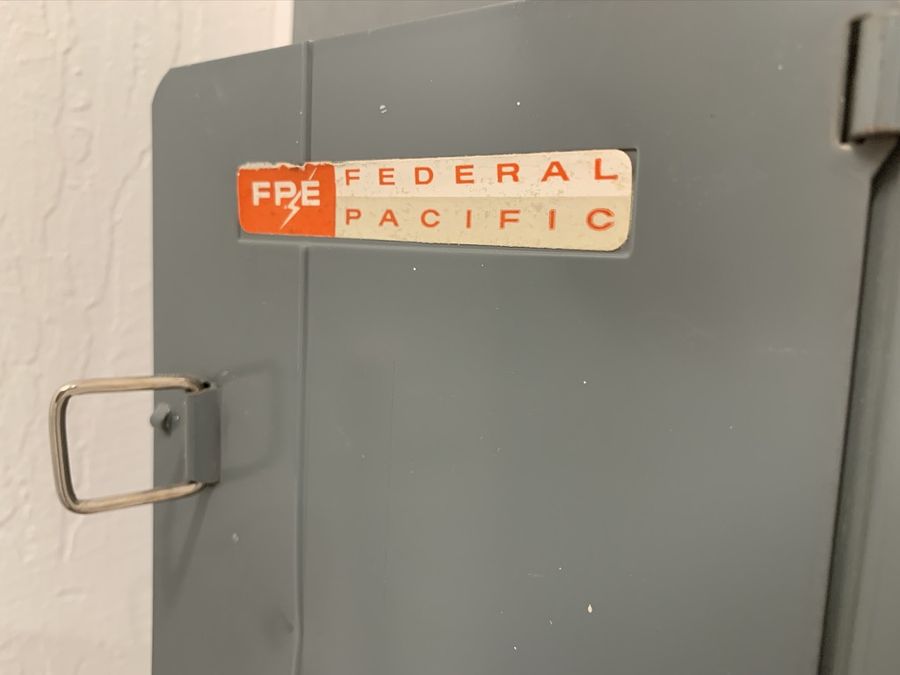
Federal Pacific electrical service panel in a San Francisco home.
Find this, price it in. Federal Pacific main service panels — long-discredited manufacturer, overstated breaker ratings, fire risk. Replace them.

Same vintage, same builders, same problems. Budget for these:

  • Dry rot, termites, wood-boring beetles — it’s damp out here. $10,000–$20,000 of work is a normal report
  • Gravity furnaces — the robot octopus in the garage, ductwork wrapped in asbestos tape ($7,000–$9,000)
  • Service under 100 amps — a real problem for an EV charger, a heat pump and an induction range ($10,000–$50,000)
  • Single-pane windows ($10,000–$20,000); roof and skylights ($10,000–$20,000)
  • Sewer laterals — shifted clay pipe ($7,000–$15,000); galvanized supply lines instead of copper
  • Terrazzo stair leaks and spalling ($5,000–$15,000)
  • No externally vented cooking, poor moisture barriers, mold — and weathering on whichever elevation faces west
A District 2 institution

The pastel bathroom

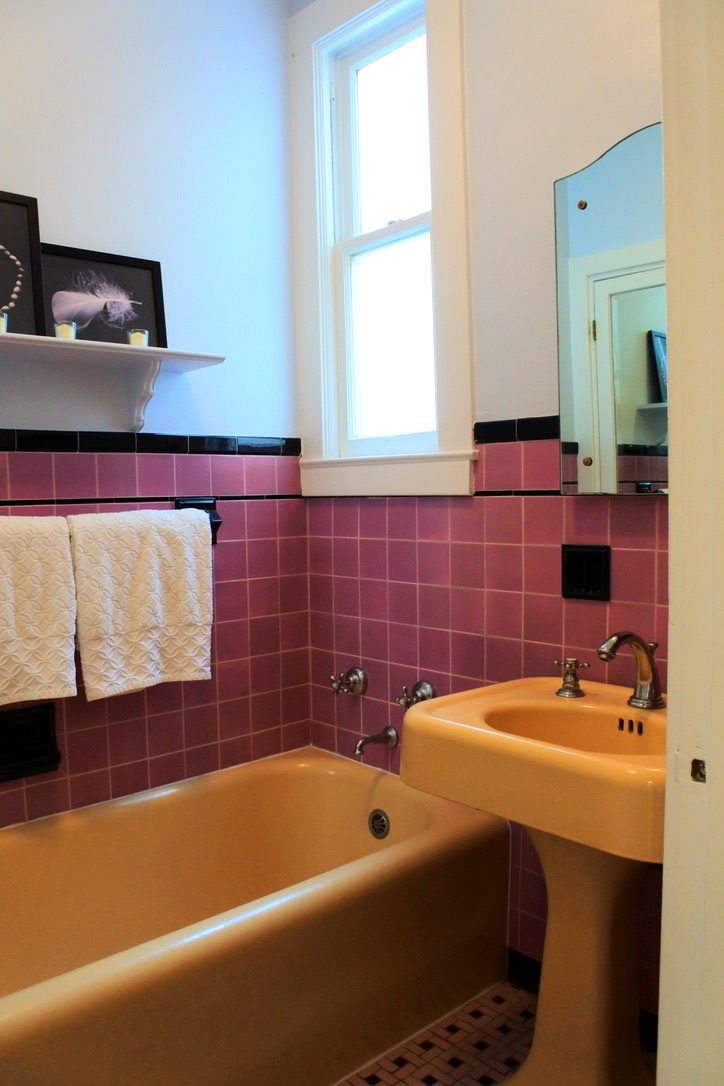
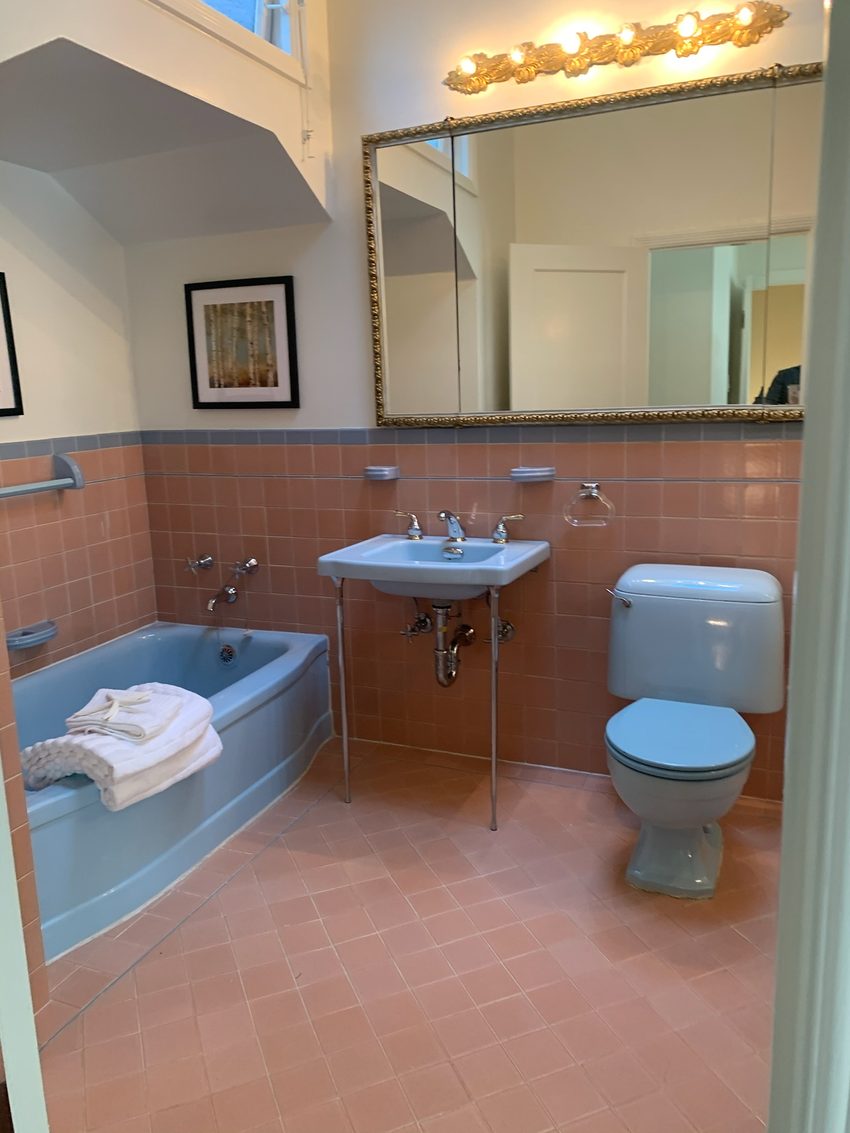
Coral, peach, salmon, mint, lavender and that particular oxblood pink. Original tile is the single fastest way to date a Sunset house — and, increasingly, a thing buyers are choosing to keep rather than demo. It’s also where this page got its palette.

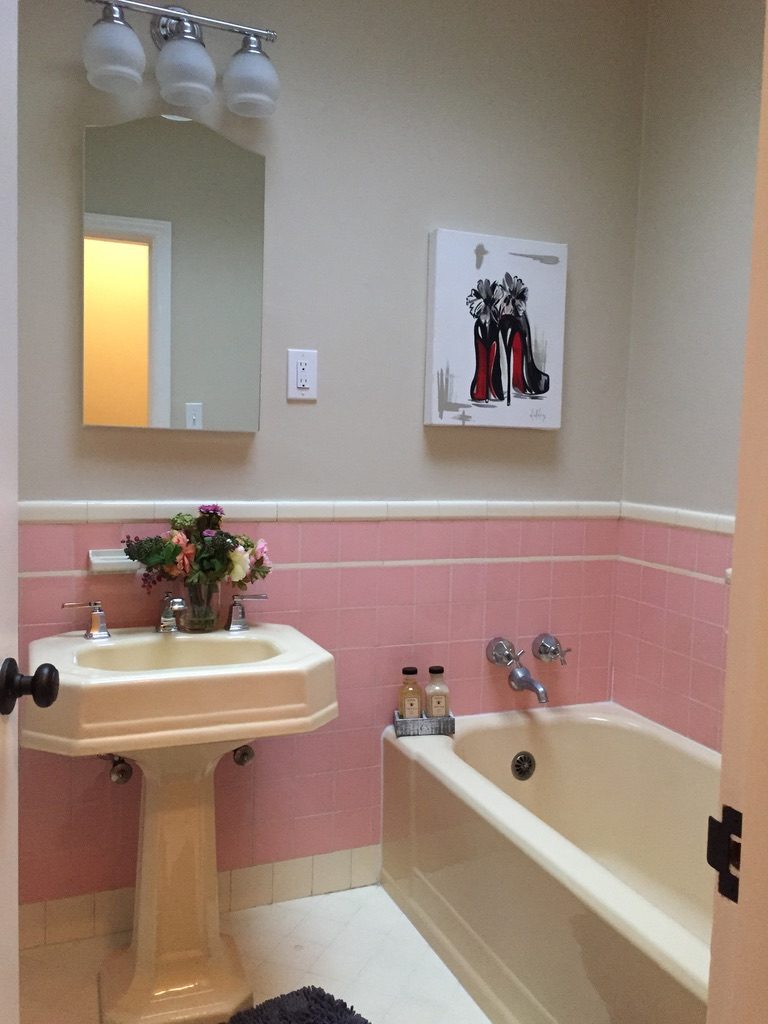
Vintage pink and cream tiled bathroom in a District 2 home.
Pink and cream. Wainscot tile with a bullnose cap, cream fixtures, a recessed soap dish. The default, and the most common.
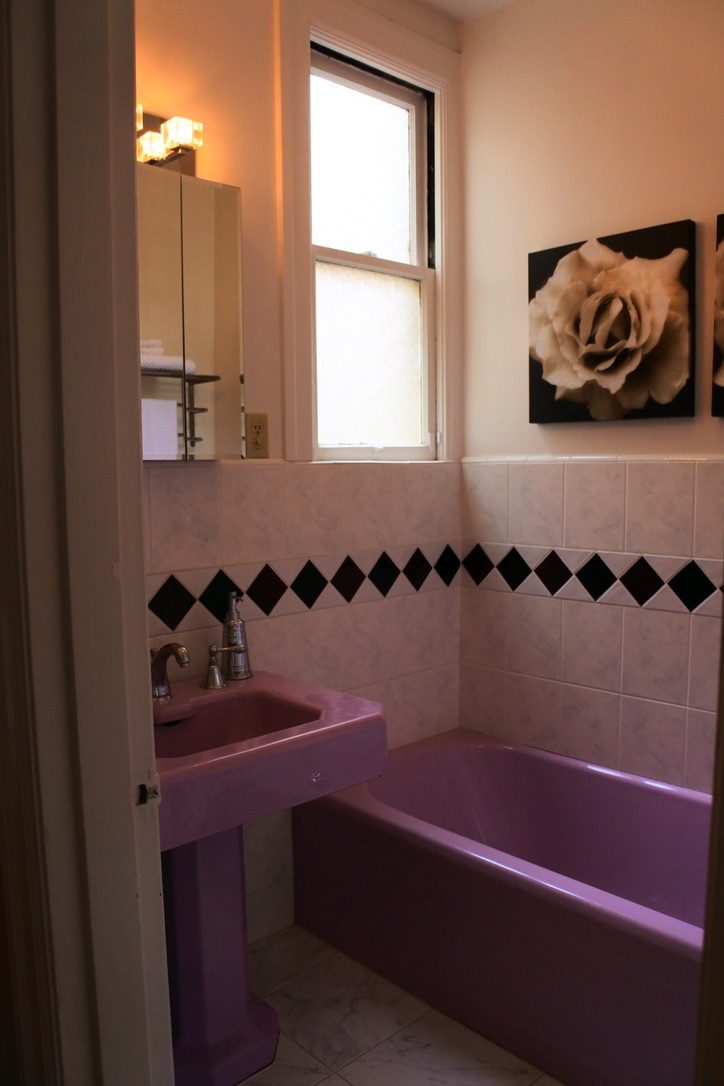
Vintage lavender bathroom with a black diamond tile border in a District 2 home.
Lavender with a black diamond border. The fixtures are the tell — colored porcelain was a factory option, not a refinish.
Vintage oxblood and peach bathroom in a District 2 home.
Oxblood and peach. Two colors that should not work together and completely do. Replacing this costs money and buys you beige.
Vintage salmon and powder blue bathroom in a District 2 home.
Salmon and powder blue. The full matched suite — tub, console sink on chrome legs, toilet — with the tile carried straight across the floor. A grey-blue cap course ties it together. This is the one worth keeping.
The oceanfront

The Sunset Dunes question

The biggest open item in District 2, and anyone buying here before November should understand it.

November 2024

Prop K passes, authorizing permanent closure of the Upper Great Highway.

April 12, 2025

Sunset Dunes opens — roughly two miles of oceanfront park, Lincoln to Sloat.

September 16, 2025

Supervisor Joel Engardio is recalled at about 63% — the first supervisor recall in the City's history.

Late 2025 → June 2, 2026

Alan Wong is appointed, then wins the special election.

January 5, 2026

The lawsuit challenging Prop K is dismissed.

July 23, 2026

A measure to restore weekday car traffic qualifies for the November 3 ballot. It would keep the park on weekends only; City records put the cost of reversing the infrastructure at $10.75M to roughly $14M.

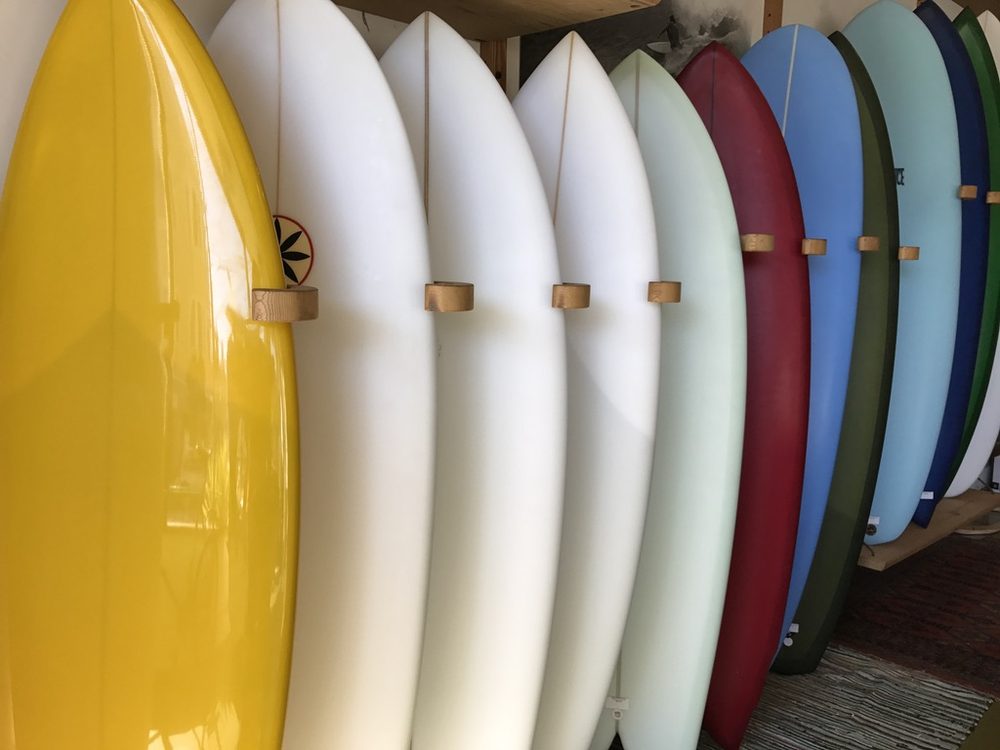
Surfboards stored in a garage in San Francisco's western neighborhoods.
Who actually uses the west end. The board rack in the garage is not a lifestyle accessory out here; it's a commute.

Year one, by the numbers

  • About 1.7 million visits, roughly 39,800 a week
  • About 60% of them on weekdays — the central fact in the ballot fight
  • Amenities by cross-street: music at Judah, a sunset lounge at Noriega, fitness and nature play at Rivera, hammocks at Taraval, a skate park and bike pump track at Sloat
  • Nearby merchants reported revenue up as much as 44%; measured rush-hour commute impact came in under 1.5 mph

Our take

A take rather than a prediction: it’s genuinely unresolved, the district is genuinely split, and it will be decided by people who live on these blocks.

What we’d tell a buyer is narrower and more useful — the blocks nearest the park have already repriced. 1956 Great Highway closed at $3,500,000, or 234% of list, in May 2026: the single highest sale-to-list ratio in the entire eleven-year dataset. The record District 2 sale remains 2020 Great Highway at $7,100,000 in June 2025.

If November goes the other way the park doesn’t vanish — it becomes a weekend park, and the oceanfront is still the oceanfront. We wouldn’t buy or not buy on the ballot.

Zoning

"Nothing ever changes out here" is no longer safe

For twenty years the answer to can they build something big next to me? was basically no. That answer is now different, and District 2 is where it’s most different.

The Family Zoning Plan — effective January 12, 2026

  • Height limits on the order of 85 feet on Judah, Noriega and Taraval. Planning’s own illustrations use an 85-foot example at Noriega and 25th Avenue
  • Merchant and transit corridors upzoned to roughly six to eight stories, with Irving, Judah, Noriega and Taraval confirmed on the final map. Sunset Boulevard, notably, was not upzoned
  • Density limits removed on interior blocks within existing height envelopes — typically four stories, up to six on corner lots and parcels of 8,000 sqft or more
  • Two lawsuits pending — one arguing the City needed more environmental review, one arguing the plan doesn’t produce enough housing. Neither decided

SB 79 — operative July 1, 2026

The state transit-oriented density law. San Francisco adopted a locally tailored alternative plan rather than the state defaults (ordinance signed May 8, 2026). The N Judah, the L Taraval and the 28R on 19th Avenue all qualify — which puts practically the entire Sunset and Parkside within a half mile of qualifying transit.

It’s already producing filings

  • 2513 Irving — filed August 2026 for nine units in three four-story buildings, explicitly under the new plan. The tell that this is real
  • 2700 Sloat — the old Sloat Garden Center site, floated as a 50-story tower in 2023 before that was abandoned. Now proposed as two 24-story towers, 682 all-affordable units and a ground-floor grocery. Caveat worth stating plainly: the developer entity filed Chapter 11 after defaulting on a loan, and we have not confirmed a groundbreaking. Treat it as proposed.
  • 1234 Great Highway — 199 apartments plus an adult day health center
  • 3601 Lawton — eight stories replacing a gas station

Upside if you own a corner lot or a parcel on a corridor. Uncertainty if you own the house behind one. Neither is cause to panic — but we'd rather you hear it from us.

transit

Getting around, and what's open

Transit and streets

  • MUNI: the N Judah and L Taraval are the spines. From August 29, 2026, the N improves to nine-minute peak headways, the 29 Sunset gains morning capacity and evening service, and the 28R picks up a new stop at 19th Avenue and Eucalyptus. Buses substitute for the trains roughly midnight to 5 a.m.
  • The L Taraval project finished in September 2024 — $90 million, rebuilt track, new boarding islands with ramps, transit-priority signals, bulb-outs and, critically, century-old water and sewer mains replaced underneath. That corridor won’t be torn up again for a generation. An underrated selling point for Parkside and the Central Sunset
  • Slow Streets and Neighborways: 12th Avenue from Lincoln to Lawton is the Slow Street. The separate Sunset Neighborways program — traffic calming rather than a through-traffic restriction — has finished Ortega, went into construction on Kirkham in April 2026, and resumes design on 41st Avenue late this year
  • Ocean Beach south of Sloat: the buried-seawall adaptation project slipped from 2027 to late 2029 for major construction, running about four years from there

Schools

Worth being precise, because there’s been noise. SFUSD floated a closure list in October 2024 — no Sunset or Parkside elementary was ever on it, and the plan was scrapped. The district balanced its 2026–27 budget and averted a state takeover. A new student assignment system is due by April 2027 and takes effect in 2028; closure conversations are deferred until after that.

The neighborhood right now

The commercial story is the most encouraging thing out here, and it’s happening at the western edge — which would have sounded absurd in 2016.

  • Recently open: Ruby’s on Judah (February 2026), Fifty Vara at 1735 Noriega, Two Pitchers x Maillards near the beach, Pàng on 9th Avenue, Black Jet Luncheonette
  • Coming: Abanico Coffee Roasters at 424 Irving (late September), Bare Bones at 2325 Taraval (October)
  • Lost: Hong’s Kitchen at Noriega and 46th, after sixteen years
  • Sunset Night Market on Irving, roughly 19th to 26th Avenues, 5–10 p.m. — September 25 and December 11
  • Outer Sunset Farmers Market & Mercantile, Sundays 9–2 year-round on 37th Avenue between Ortega and Quintara
  • Outside Lands ran August 7–9. And the City has approved a second, separate festival in the park on an adjacent August weekend starting in 2027 — the concert season gets longer, not shorter


The commercial spine has genuinely thickened past 40th Avenue, with the newest cluster around Judah at 45th and 46th and now Irving at 46th.

Buyers and inventory

Who's winning these house

Who’s buying

  • Couples starting a family, and families with one or two small children
  • Multi-generational households — this is the district built for it, because the downstairs space is already there
  • Parents buying for adult children
  • Peninsula commuters who did the math on 280 versus a Caltrain platform
  • Buyers who want the beach and the surf, and are frank about it
  • Less often, flippers and developers. Almost never, buy-and-hold rental investors


Cash is now 29.3% of sales, up from 12.6% in 2020; conventional financing accounts for 60.2%. That’s a meaningful shift in who can win.

Out back, not the box

The tell for a serious District 2 renovation isn't a Noe Valley-style rear box. Expansion out here happens by filling in the underutilized ground floor and adding living area at the rear. Which is why four-plus-bedroom sales climbed from 25.1% in 2015 to 32.5% in 2026, and the median house sold grew from 1,550 to 1,692 sqft. The district is quietly getting bigger without getting taller.

And about that warrant: a lot of downstairs space out here is unwarranted. In most cases it has at least eight feet of ceiling height, which makes it a legitimate candidate for legalization in a remodel. It won't show in the listing's square footage — but most appraisers who work this district count it, because out here it's the norm rather than the exception.

The three buckets

  • The estate fixer — vacant, as-is, 50/50 it’s a real project. Low list, wildest ratios. Court confirmation is rare now: 0.4% of 2026 sales, down from 1.6% in 2015
  • The 1980s–90s remodel — the genuine hidden gem. Finishes that were nice then and read dated now, on a house that needs cosmetics rather than surgery. Most buyers lack the vision or the patience, which is exactly why the math works
  • The flip, in three tiers: contractor-grade with five bedrooms and a garish LED chandelier, pushing $2M and raising questions about what got cut; owner-built or done by a developer who knows the district; and the genuinely exceptional renovation, $2.6M to well past $3M


9.4% of 2026 sales closed at or above $3M, against 2.7% in 2025 and essentially zero in 2016. The top of this market is real now — 1359 5th Avenue at $5,900,000, 50 Cascade Walk at $5,167,500 ($1,855/sqft), and 931 Kirkham at $4,239,310, which closed at 177% of list in eight days.

What's in a name

The grid, explained

A street naming commission laid out the district’s nomenclature in 1909, ratified by a citywide vote that November. East-west streets run alphabetically — Xavier was on the list and got dropped as unpronounceable, which is why Wawona hands straight off to Yorba — and numbered avenues run north to south.

And there is no 13th Avenue. The popular version is that 1900s San Francisco wasn’t going to press its luck. The actual reason is that it was renamed Funston Avenue for General Frederick Funston. We’ve told the superstition version for years; the record says otherwise, and the record is the better story.

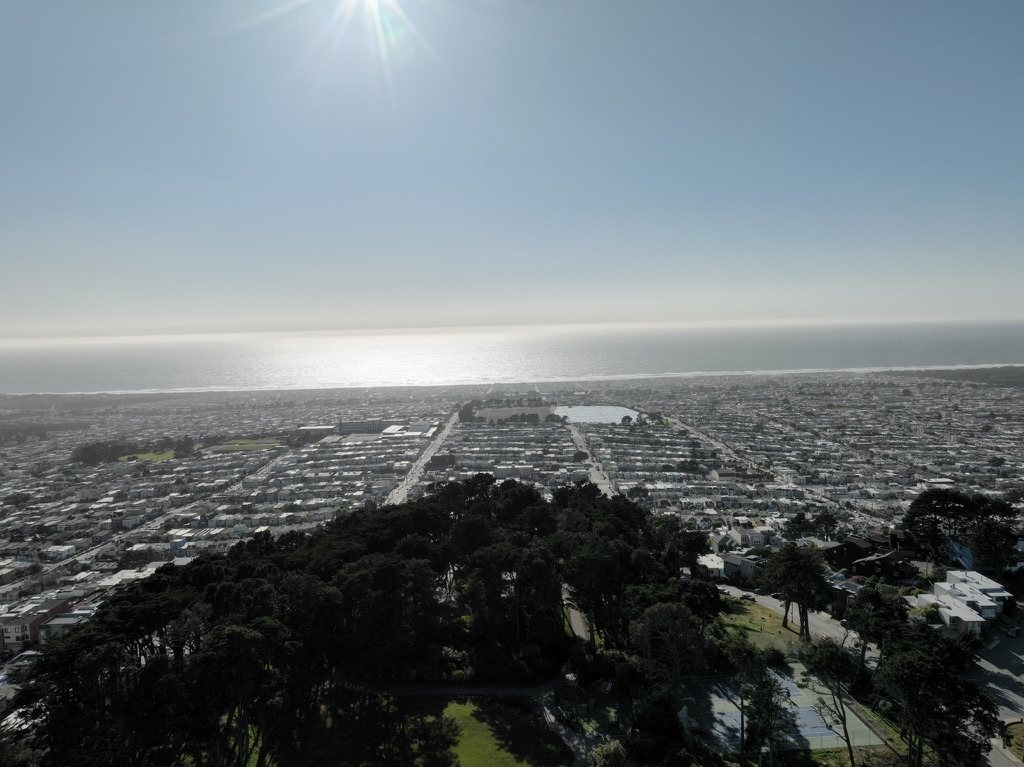
View across San Francisco from District 2
Let's talk

No one has ever bought a median.

Every number on this page is one. The Outer Parkside fixer on the 4,000 sqft corner lot and the Inner Sunset Arts & Crafts house with its original woodwork are both “District 2” and have almost nothing to do with each other. What we do is figure out which house you’re actually standing in front of, what it will cost to make it yours, and what it will genuinely take to win it.

Kevin Ho · Team K.Ho, Vanguard Properties

Serving the Sunset, Parkside, Golden Gate Heights and all of San Francisco

Sources: San Francisco MLS — 4,988 District 2 single-family sales closed April 1, 2015 through August 21, 2026, analyzed by Team K.Ho. Subdistrict boundaries assigned by Team K.Ho from street and avenue position; the MLS reports District 2 as a single area. Rate data: Freddie Mac PMMS, week of August 20, 2026. Policy, development and neighborhood items current as of August 24, 2026. All photographs © Team K.Ho. Every property, every seller and every buyer is different — nothing here is a substitute for advice on your specific situation.