
Bayview/Crocker Amazon/Portola/Excelsior
The Southeast covers a broad and varied portion of San Francisco, where residential neighborhoods, industrial zones, and waterfront areas come together. Compared to the city’s core, the pace is slower and the environment more spread out. Each neighborhood carries its own identity, but what ties the district together is a sense of practicality—this is a part of the city shaped as much by daily life as by long-term change.
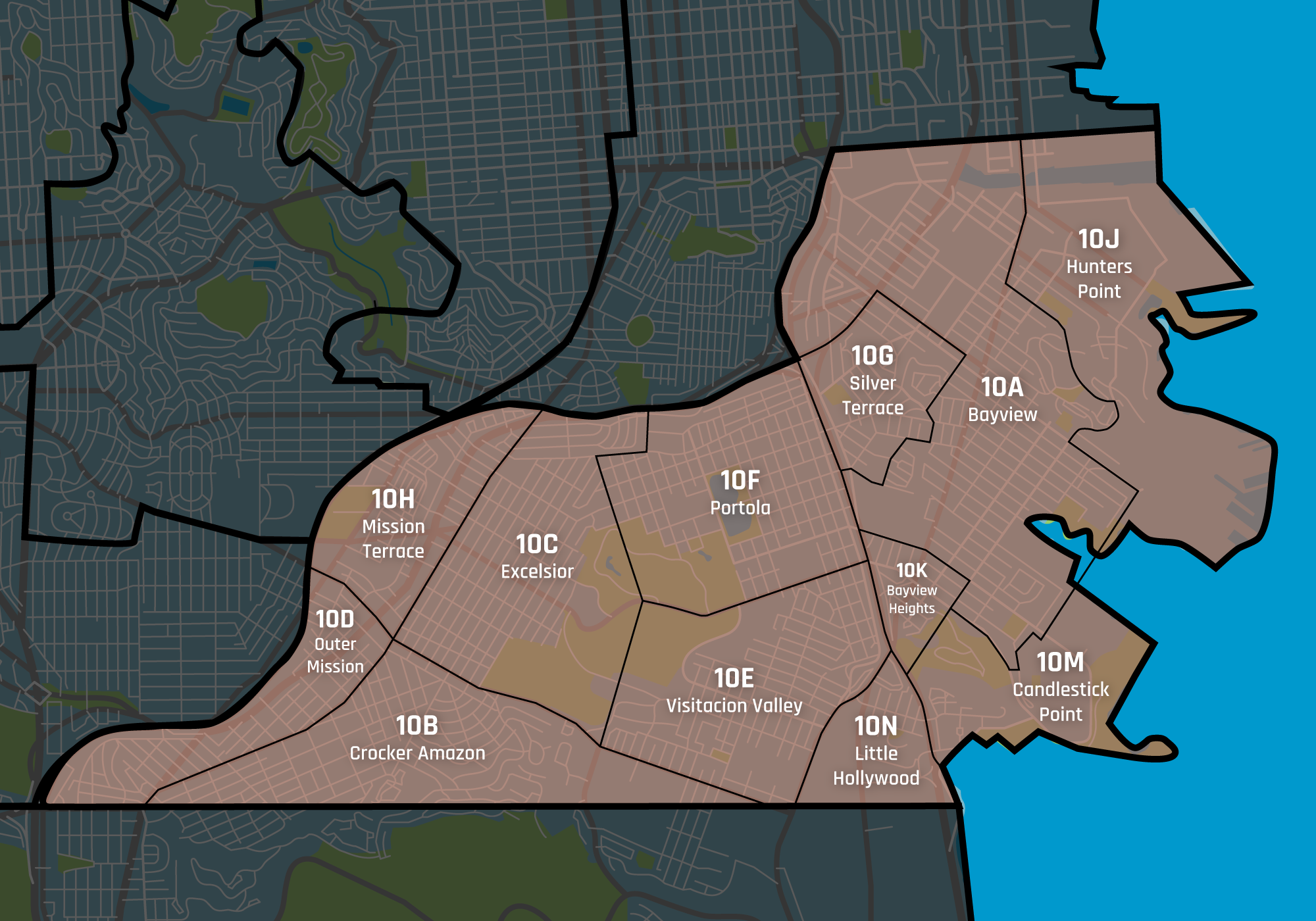
The Southeast doesn’t present itself all at once. The neighborhoods are larger, the streets less uniform, and the transitions between areas more gradual. In places like Excelsior and Outer Mission, daily life centers around local corridors—Mission Street, Geneva Avenue—where everything from groceries to transit sits within reach.
Further east, the environment shifts. Bayview, Hunters Point, and the Central Waterfront reflect a mix of residential streets, industrial edges, and ongoing redevelopment. The waterfront introduces space and light, but also a sense that parts of the district are still evolving.
Inland, neighborhoods like Portola, Visitacion Valley, and Crocker Amazon feel more self-contained, with a strong residential identity and less overlap with the city’s busier cores. Silver Terrace and Bayview Heights add elevation, with views and a slightly more open feel.
This is a part of San Francisco where the city stretches out. The density softens, the pace changes, and the experience becomes more about the neighborhood itself than the city around it.
Outer Mission • Excelsior • Mission Terrace • Crocker Amazon
Portola • Visitacion Valley • University Mound
Bayview • Bayview Heights • Hunters Point • Candlestick Point • Little Hollywood
Areas that shape the district
The Southeast offers more space and relative affordability, but it varies widely by neighborhood. Some areas feel established and residential, while others are still evolving, making location and surroundings especially important.
What You Notice Over Time
Primary commercial strip with transit, shops, and daily services
Local access point connecting multiple neighborhoods
Open space, industrial edges, and ongoing development
Local shops, markets, and a true neighborhood rhythm
Where Daily Life Happens
And Who Feels at Home Here
The Southeast covers a broad and varied portion of San Francisco, where residential neighborhoods, industrial zones, and waterfront areas come together. Compared to the city’s core, the pace is slower and the environment more spread out. Each neighborhood carries its own identity, but what ties the district together is a sense of practicality—this is a part of the city shaped as much by daily life as by long-term change.
The Southeast doesn’t present itself all at once. The neighborhoods are larger, the streets less uniform, and the transitions between areas more gradual. In places like Excelsior and Outer Mission, daily life centers around local corridors—Mission Street, Geneva Avenue—where everything from groceries to transit sits within reach.
Further east, the environment shifts. Bayview, Hunters Point, and the Central Waterfront reflect a mix of residential streets, industrial edges, and ongoing redevelopment. The waterfront introduces space and light, but also a sense that parts of the district are still evolving.
Inland, neighborhoods like Portola, Visitacion Valley, and Crocker Amazon feel more self-contained, with a strong residential identity and less overlap with the city’s busier cores. Silver Terrace and Bayview Heights add elevation, with views and a slightly more open feel.
This is a part of San Francisco where the city stretches out. The density softens, the pace changes, and the experience becomes more about the neighborhood itself than the city around it.
Outer Mission • Excelsior • Mission Terrace • Crocker Amazon
Portola • Visitacion Valley • University Mound
Bayview • Bayview Heights • Hunters Point • Candlestick Point • Little Hollywood
Areas that shape the district
The Southeast offers more space and relative affordability, but it varies widely by neighborhood. Some areas feel established and residential, while others are still evolving, making location and surroundings especially important.
What You Notice Over Time
Primary commercial strip with transit, shops, and daily services
Local access point connecting multiple neighborhoods
Open space, industrial edges, and ongoing development
Local shops, markets, and a true neighborhood rhythm
Where Daily Life Happens
And Who Feels at Home Here