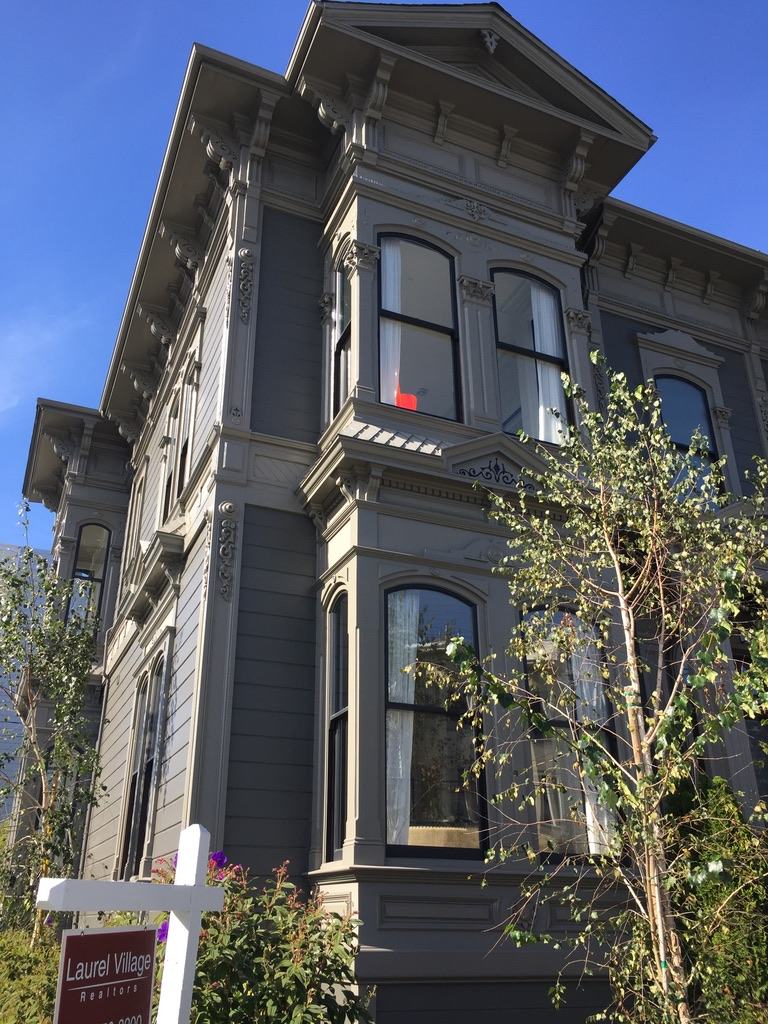
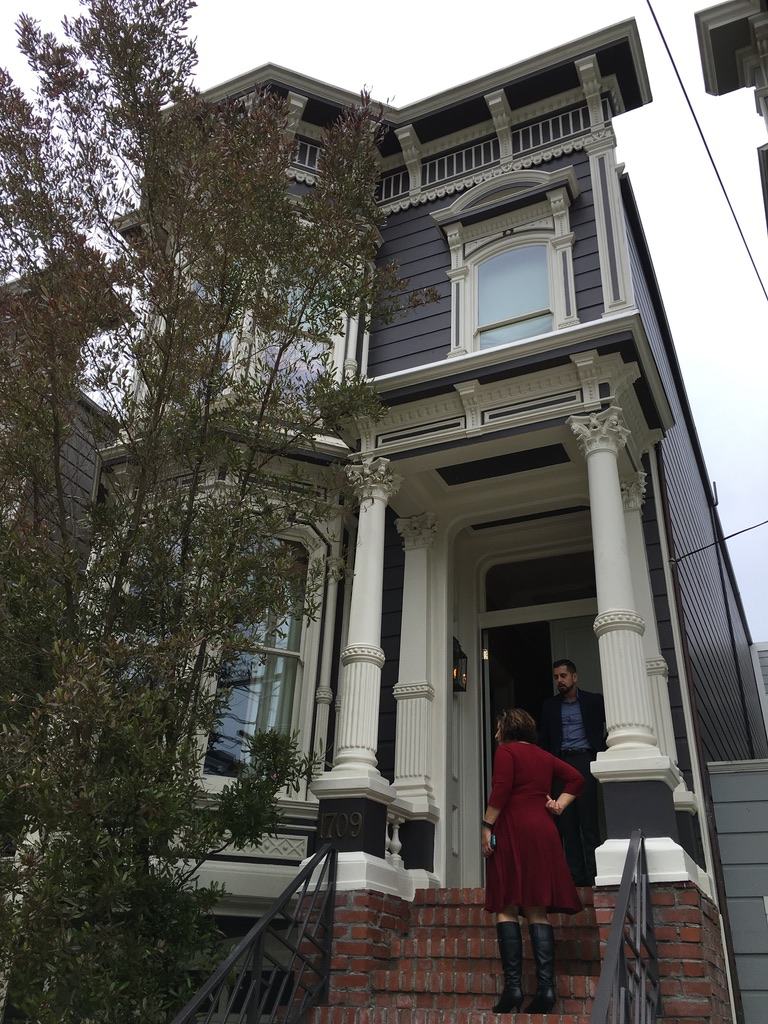
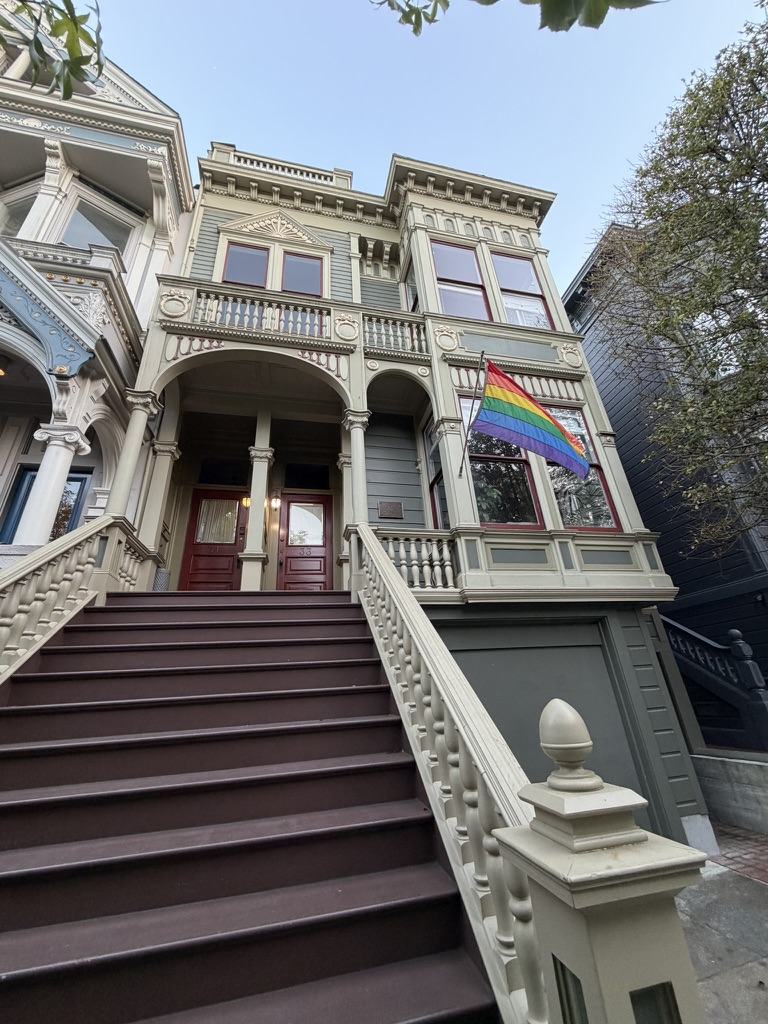
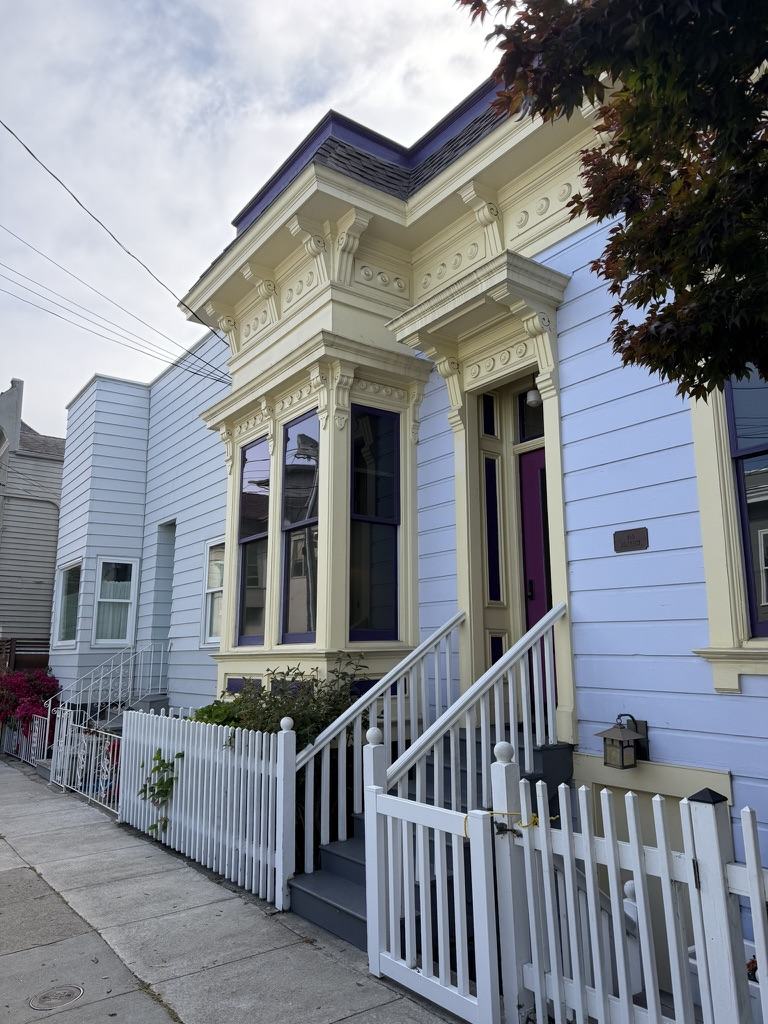
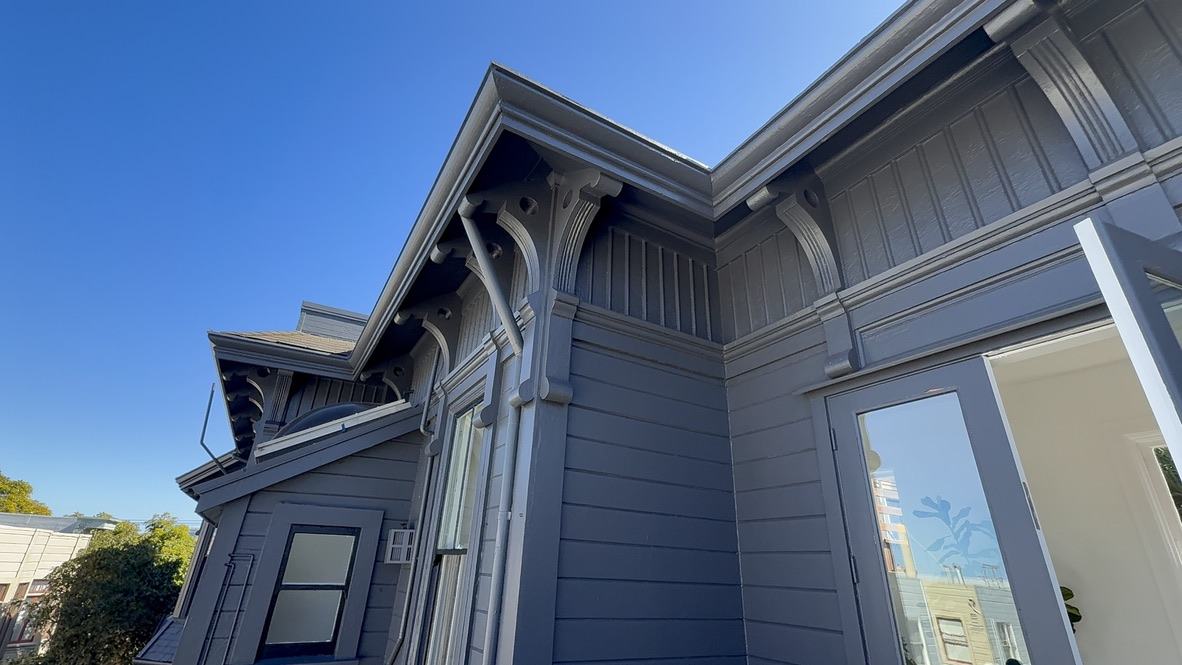
San Francisco Architectural Styles: Victorians, Painted Ladies, Edwardians & Craftsman | Team K.HoPhoto: Kevin Ho
The District Survey · Buyer's Field Guide
The City's Architectural Styles
Italianate or Queen Anne? Victorian or Edwardian? How to read a façade from the sidewalk, and what it tells you about the house behind it.
By Kevin Ho · Team K.Ho, Vanguard Properties
1837–1906
Victorians: As San Francisco as Karl the Fog
I never thought I would live in a Victorian. I've sold a lot of them, toured even more, and helped plenty of people buy and sell them. Then, in 2025, I got a Victorian of my very own, with an iconic view and a great location.
Living in one has taught me a lot more about Victorians than any open house ever did. So this guide comes from both sides of the front door: the agent who helps people buy and sell them, and the owner who lives in one.
Victorians are as San Francisco as Karl the Fog, the Golden Gate, or high home prices. The name comes from the reign of Queen Victoria (1837–1901), and here it mostly means houses built from the 1860s up to the 1906 earthquake.
It isn't one style. It's a family: Italianate, Stick-Eastlake and Queen Anne do most of the work in the City, with the occasional Gothic Revival for good measure.
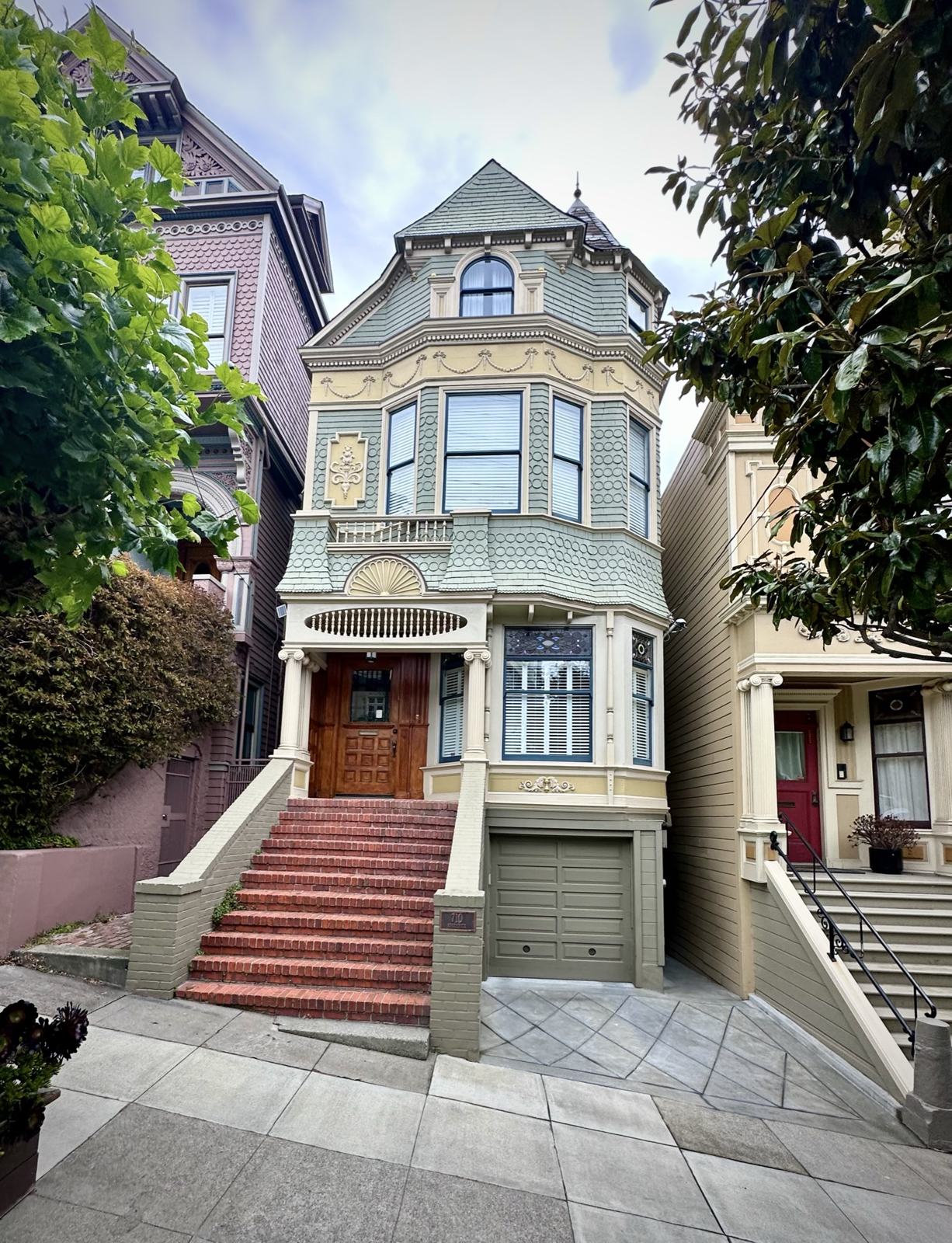
They were a reaction to the more symmetrical, formal buildings that came before. Builders suddenly had steam-powered sawmills, mass-produced millwork, plate glass and pattern books they could order from. So they went big: steep gables, bay windows, leaded and stained glass, and vines and acanthus leaves carved across the façade.
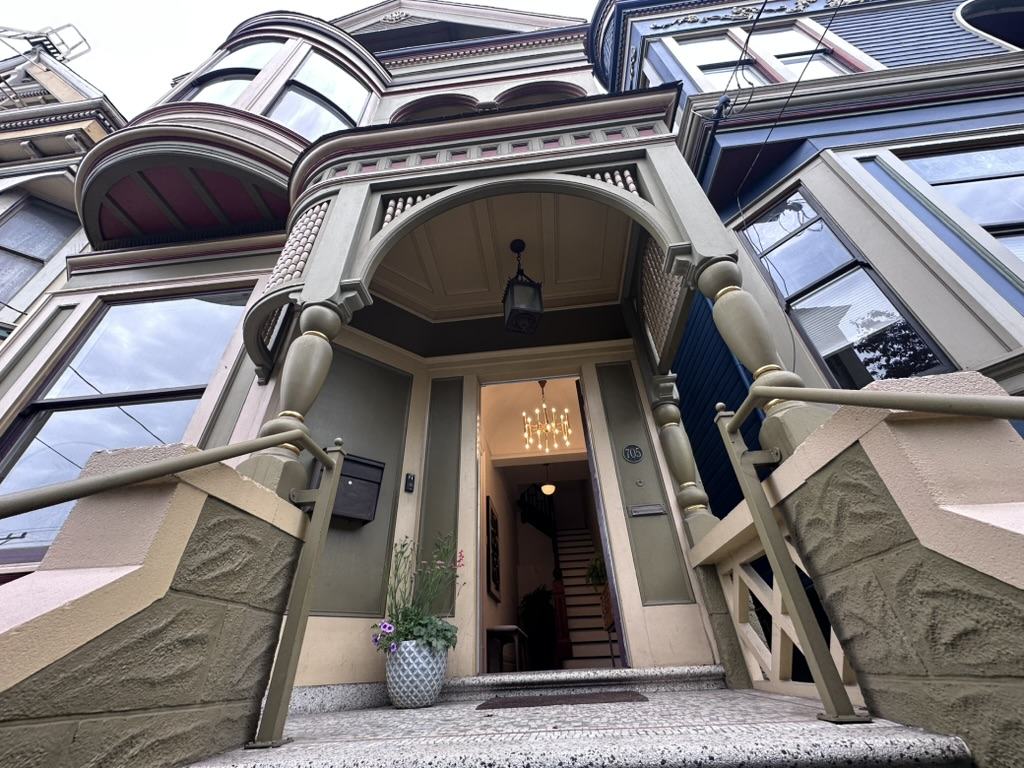
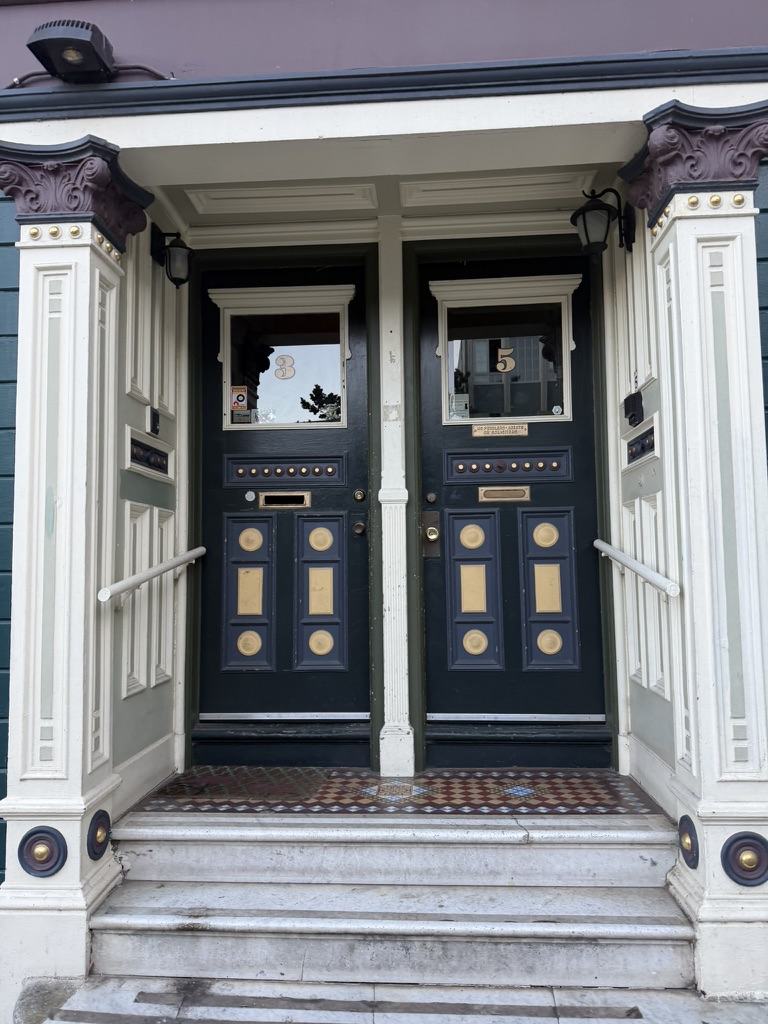
Showing off was the point. An arched entry on turned columns with a chandelier waiting inside; paired doors studded with brass under carved capitals, on a tiled floor. All of it said you could afford the best craftspeople in town. Photos: Kevin Ho
If you could afford the best craftspeople and the most ornament, the front of your house said so.
The 1906 earthquake and fire took many, especially east of Van Ness. Redevelopment took more, most heavily in the Western Addition in the 1950s and '60s. Estimates of what's left run from about 10,000 to 14,000, depending on whether you count a stucco-skinned Victorian and where you draw the line with Edwardians. Nobody keeps an official census.
Kevin's TakeTen to fourteen thousand sounds like a lot until you remember the City has roughly 400,000 housing units. Original Victorians are a small, fixed supply, and nobody is making more of them. That's why a well-kept one in District 5 or District 7 draws a crowd, and why a tired one is a project rather than a bargain. Each house is different. The permit history tells you more than the paint does.
Alamo Square · 710–720 Steiner
The Most Photographed Homes in the City: The Painted Ladies of Postcard Row
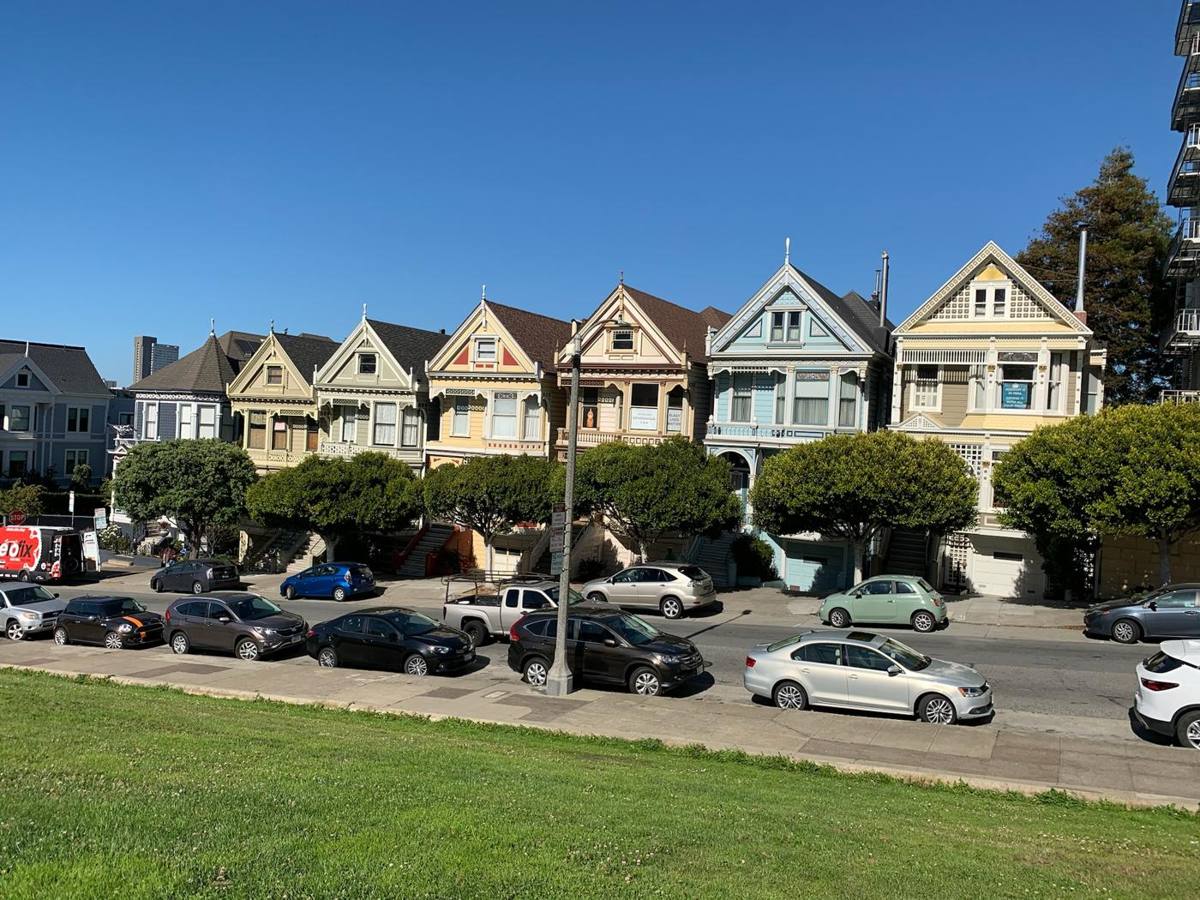
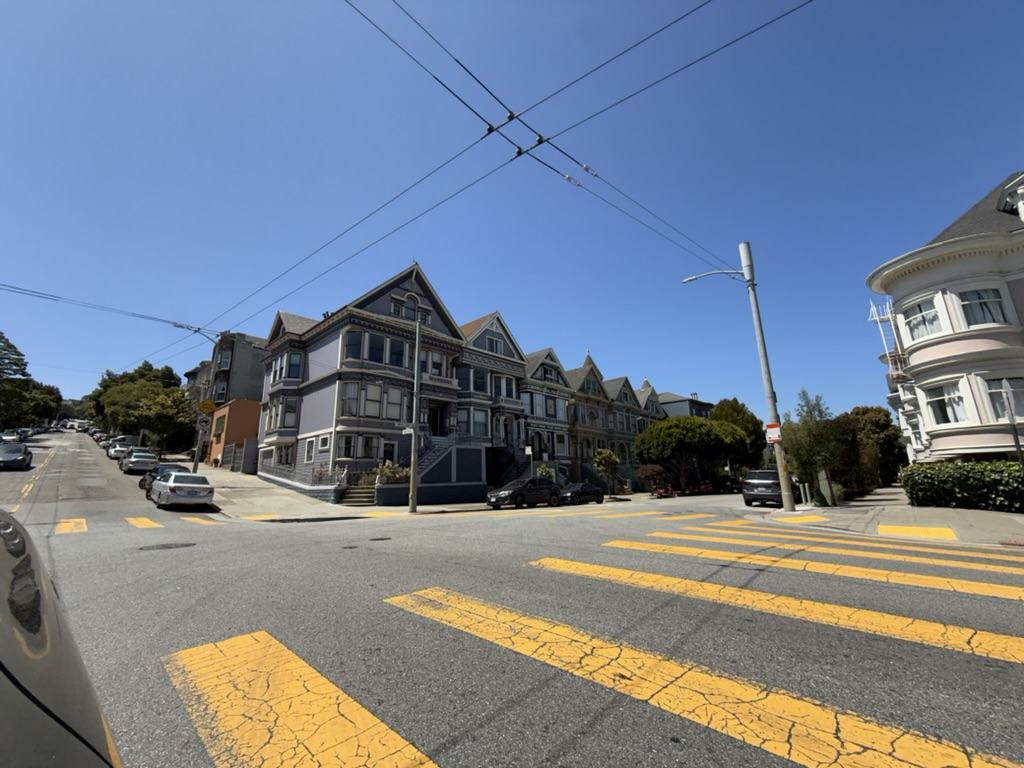
Across the lawn from Alamo Square sits the row everybody knows: 710–720 Steiner, also called the Seven Sisters. Developer Matthew Kavanaugh built them between 1892 and 1896 and lived next door at 722 Steiner. Put the downtown skyline behind them and you have one of the most photographed views in the City, sitcom opening credits included.
Postcard Row from Alamo Square. Seven Queen Anne sisters with matching gables, built over four years by one developer. Photo: Kevin Ho
But technically, Postcard Row isn't the only set of Painted Ladies. Not every Victorian is one, but many are. The term means any Victorian or Edwardian painted in three or more colors that bring out the detail, and you'll find them on blocks all over the City.
The name comes from the 1978 book Painted Ladies: San Francisco's Resplendent Victorians by Elizabeth Pomada and Michael Larsen, with photographs by Morley Baer.
The look started in 1963, when artist Butch Kardum painted his Italianate in intense blues and greens. The neighbors followed, and by the 1970s the "colorist movement" had repainted whole blocks.
Before that, plenty of these houses had been painted battleship gray, or covered in stucco and asbestos shingle to look "modern."
Walk the whole square. Around the corner from Postcard Row, another run of gabled Queen Annes, no tour buses required. Photo: Kevin Ho
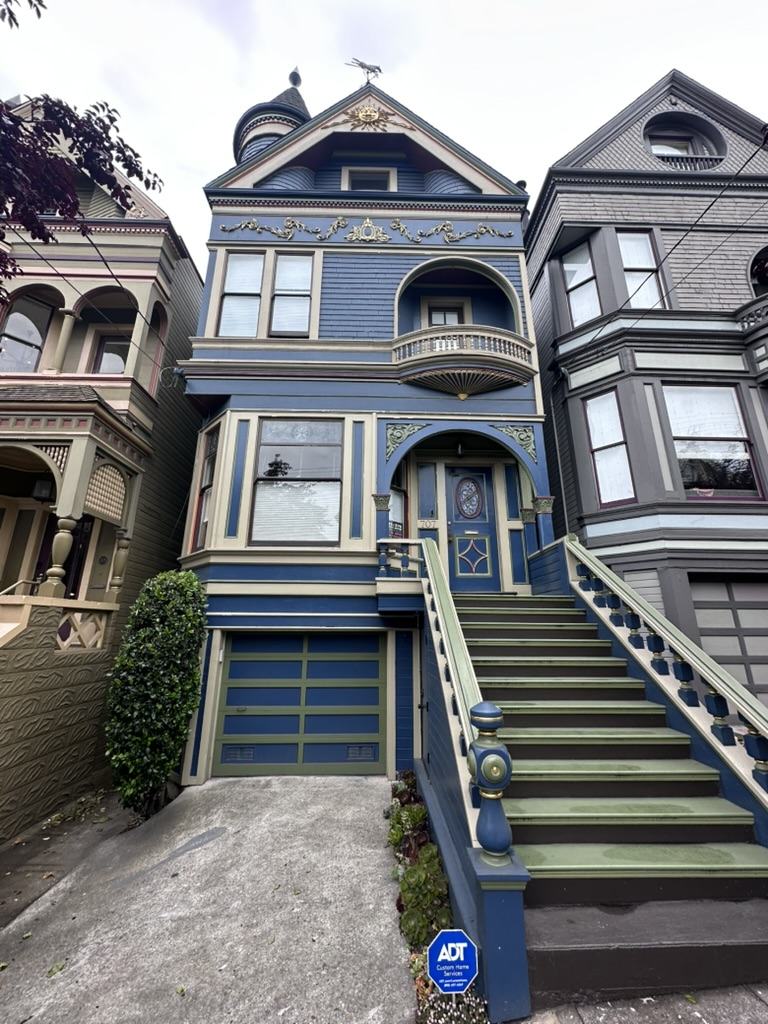
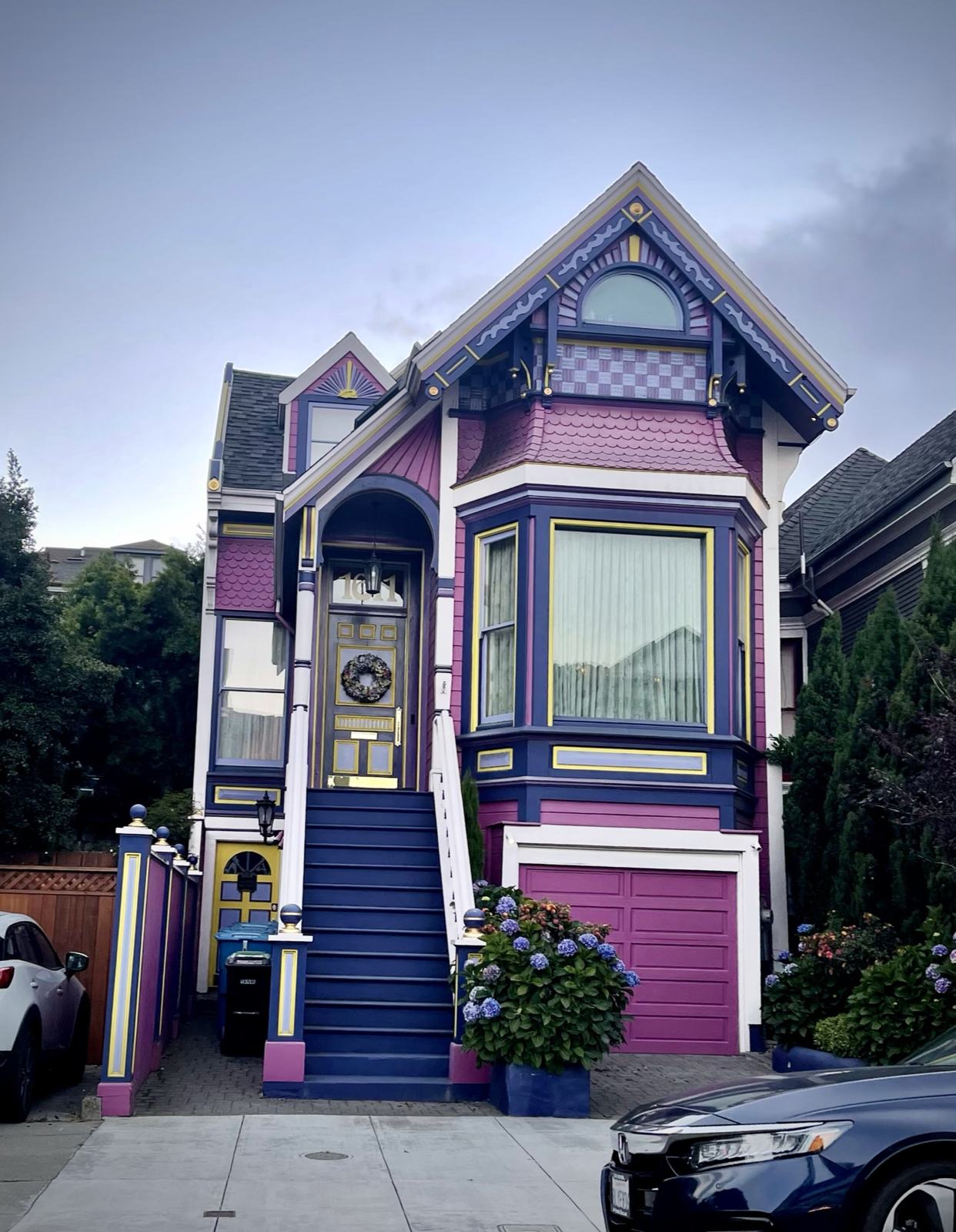
Painted Ladies, off the tour-bus route. Gilded garlands and a weathervane on one; magenta, navy and gold right down to the checkerboard in the gable on the next. Every detail picked out, nothing left plain. Photos: Kevin Ho
The colorist movement, still going
Sixty years after Butch Kardum, owners are still pushing the palette. Some go dark and dramatic, picking out every bracket in gold. Others ignore the rulebook entirely. Love it or not, it's the same idea: the paint is there to make you look at the house.
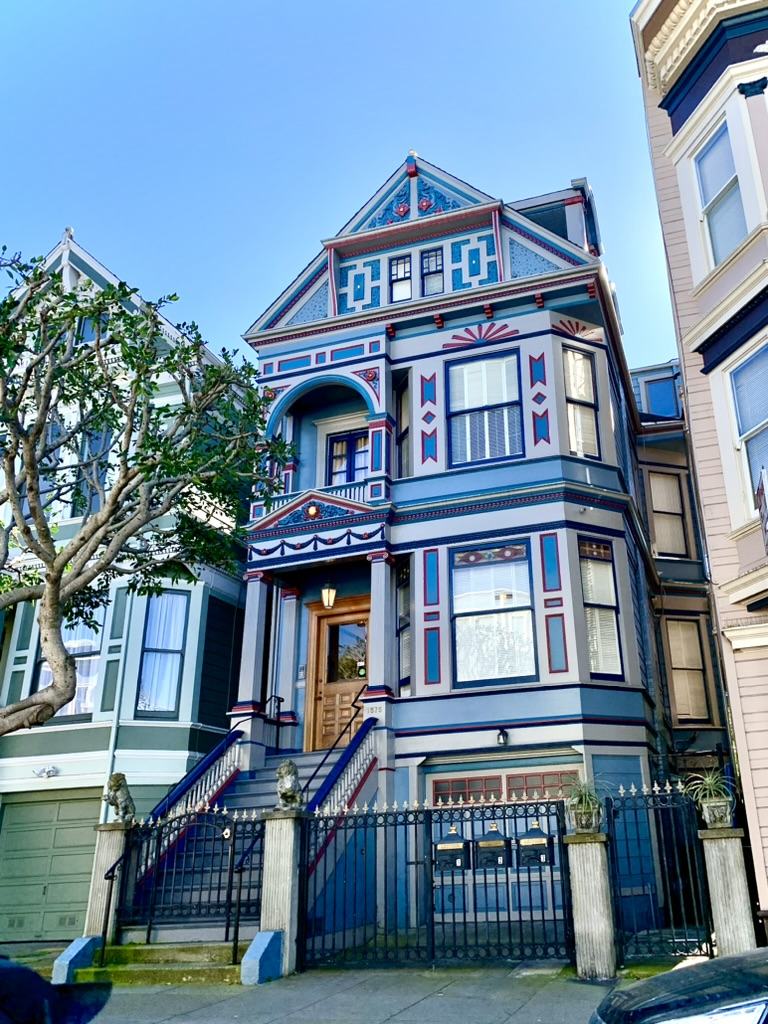
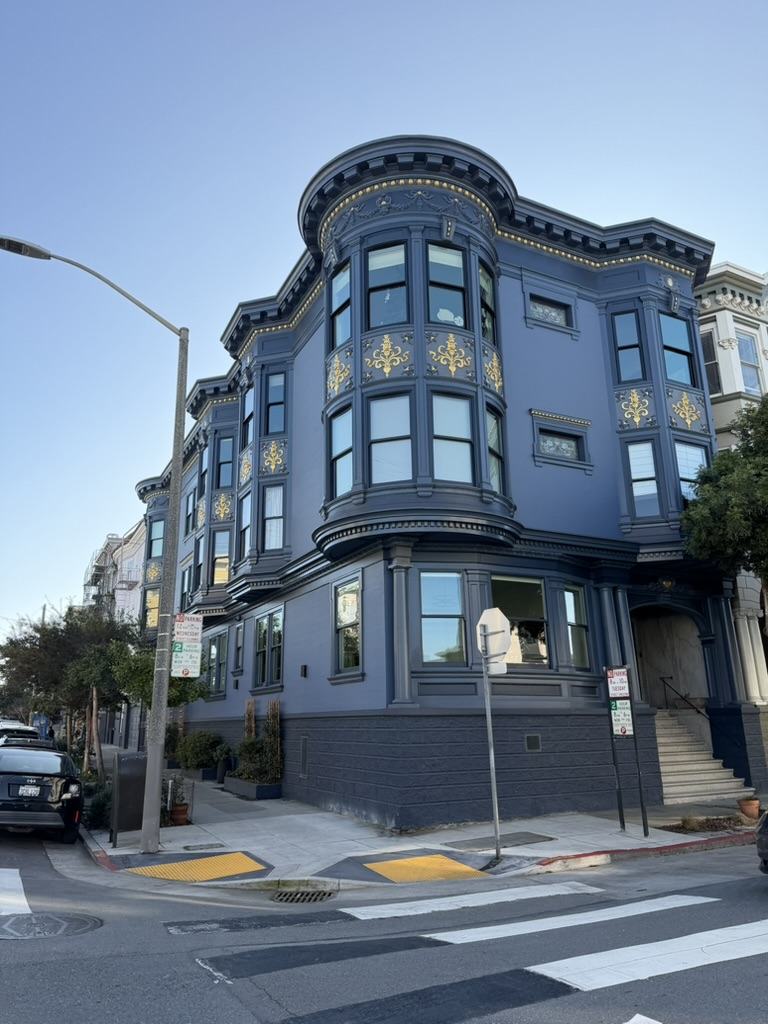
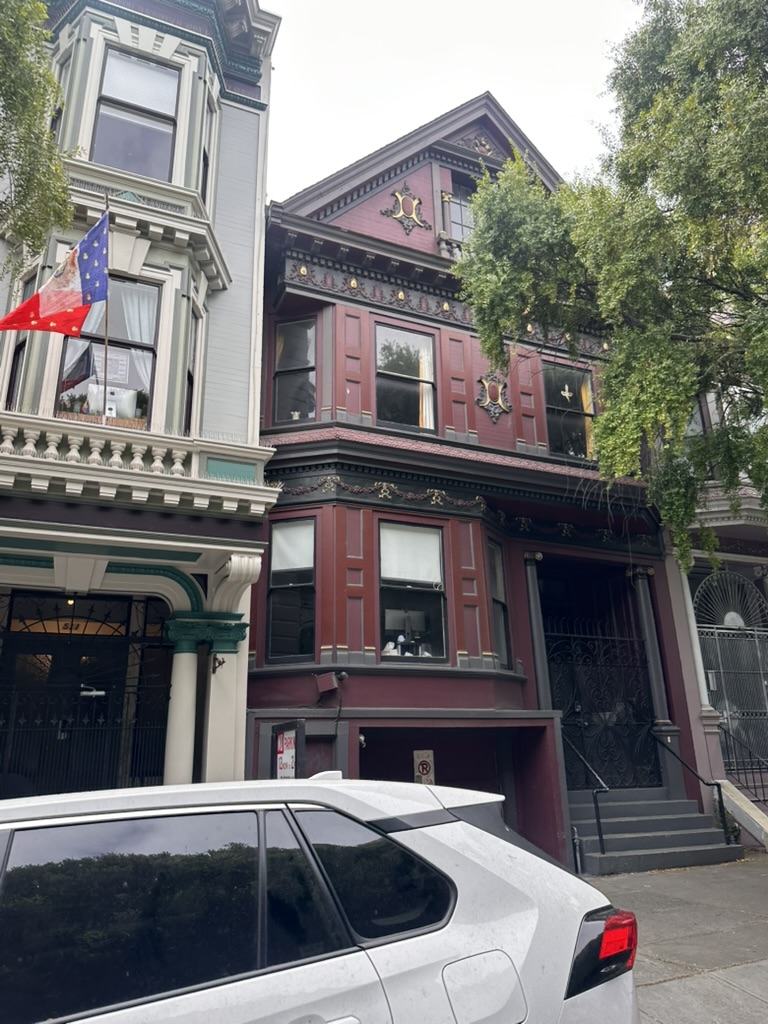
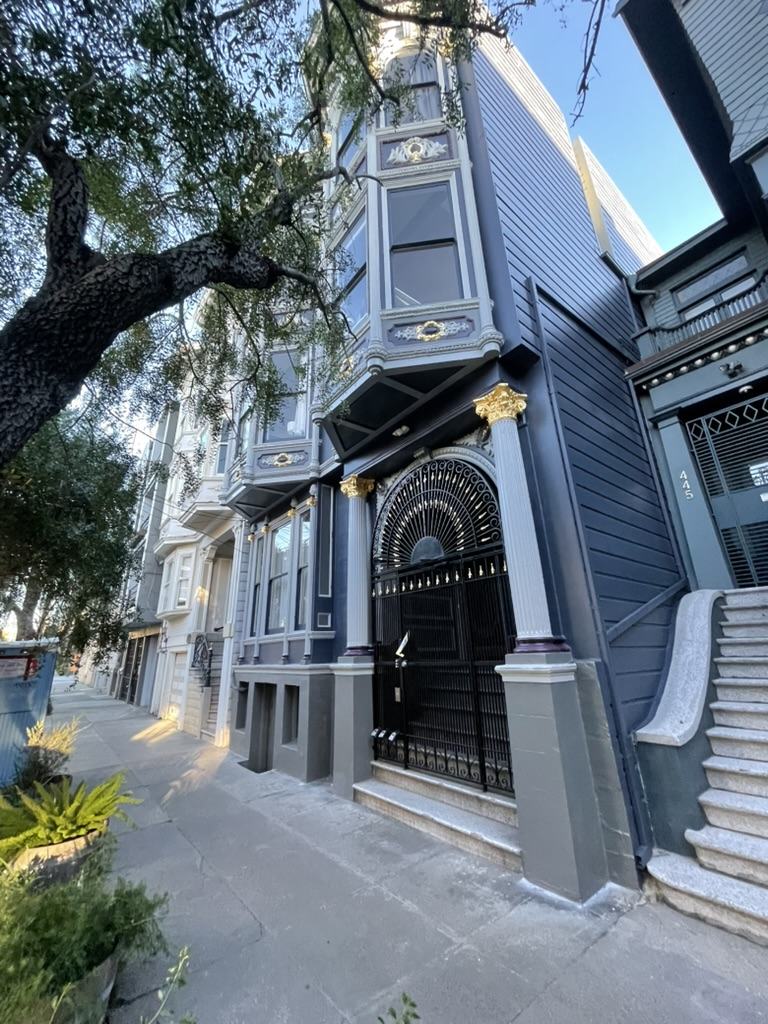
Every inch picked out. Diamonds, sunbursts and garlands in red, navy and sky blue. Photo: Kevin HoGold leaf, corner lot. Periwinkle body, charcoal base, and gilded panels under every window of the rounded bay. Photo: Kevin HoOxblood and gold. Gilded medallions and garland friezes on a deep red body. Photo: Kevin HoNavy and gold leaf. Gilded capitals and a fanlit iron gate. Photo: Kevin Ho
Style by style
Meet the Victorian Family
Three styles cover most of what you'll tour. Learn the roofline and the bay window, and you can name nine out of ten houses from the sidewalk.
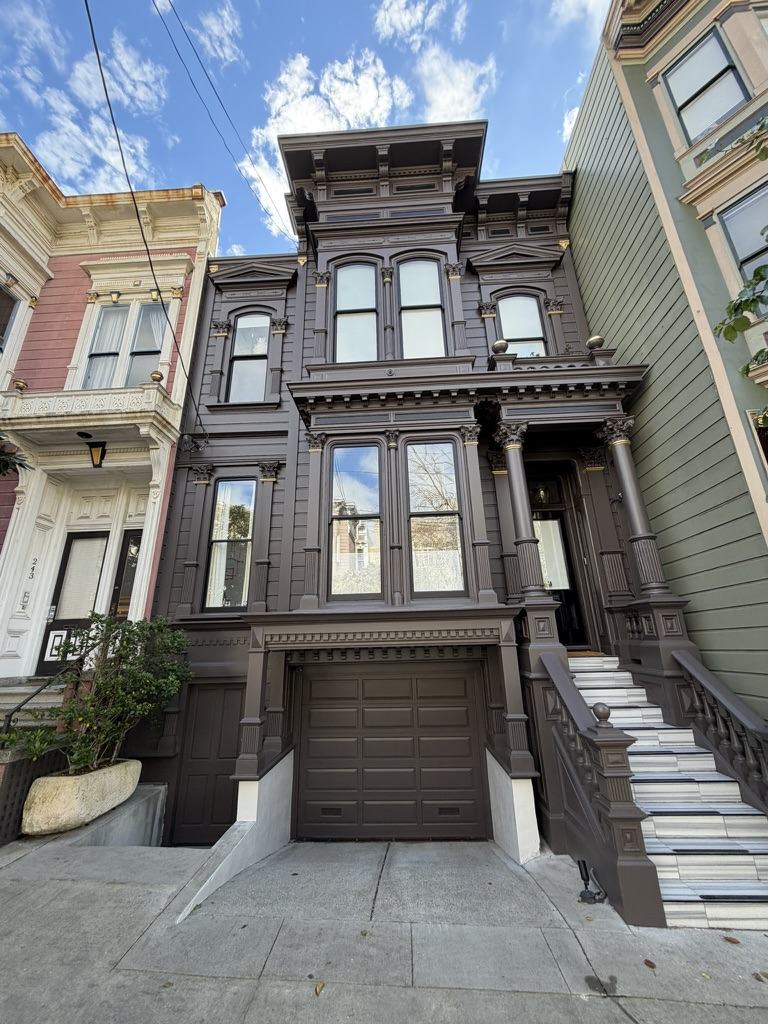
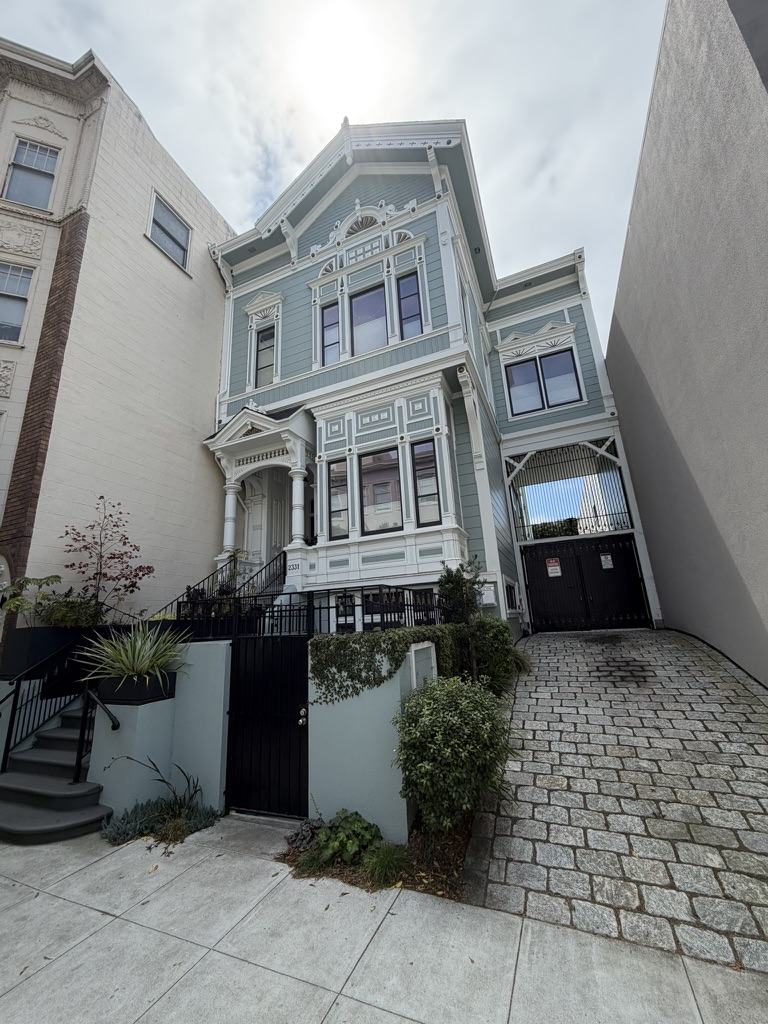
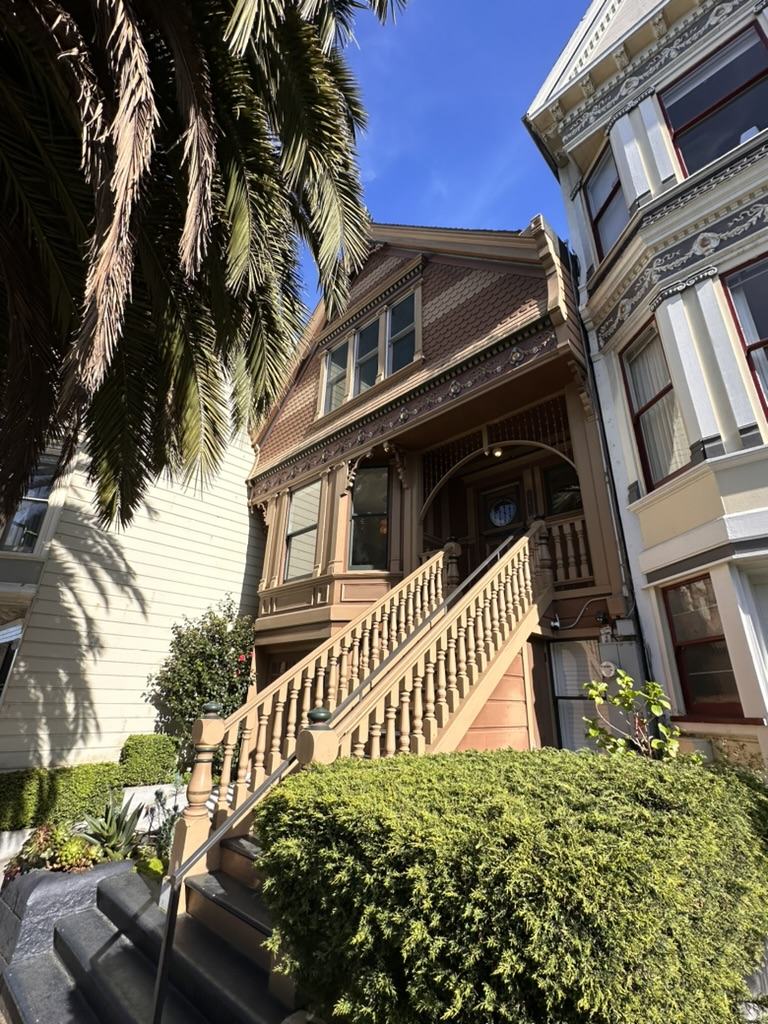
Italianate, dressed up. Corinthian columns at the door, gilded capitals, arched paired windows under a bracketed cornice, and a garage dug in later beneath the bay. Photo: Kevin Ho
About 1865–1885
Italianate
The formal one.
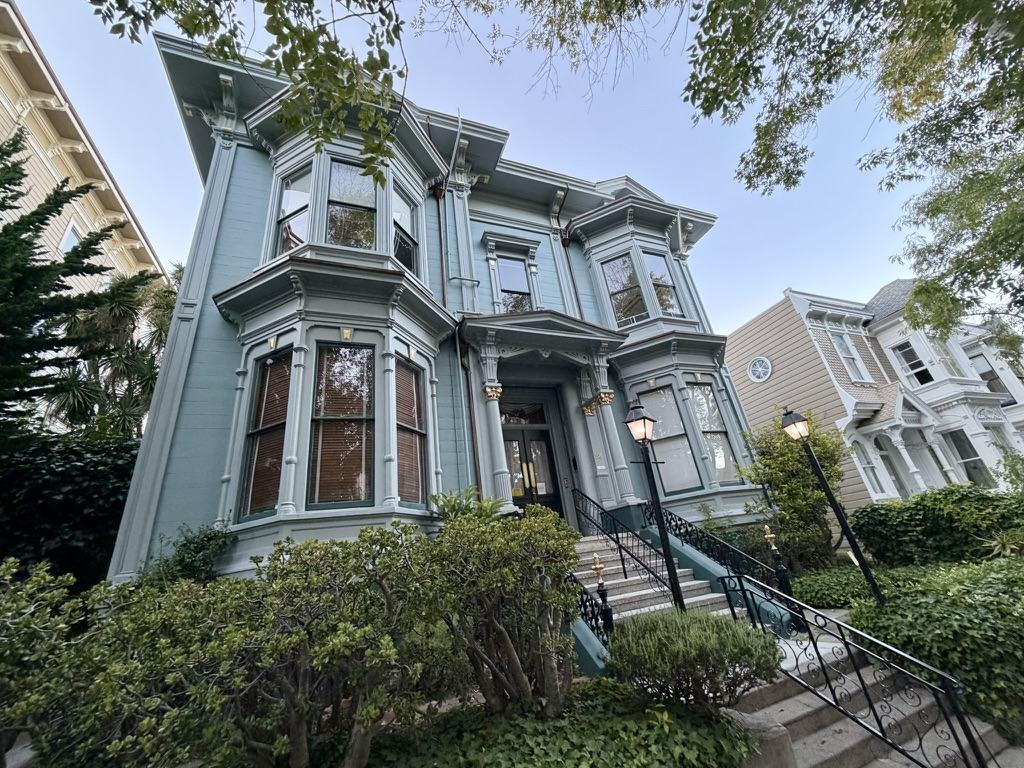
The most formal Victorian style, borrowing from Italian Renaissance design. From the street it looks square and upright, like it's standing at attention.
Spot it
Flat roof hidden behind a false front, with a heavy bracketed cornice
Slanted (angled) bay windows, usually two stories
Tall, narrow windows with arched or hooded tops
A prominent entrance with columns, a pediment and paired doors
Wood siding cut to look like stone
The early ones (1860s and '70s) are flat-fronted. The slanted-bay version took over in the 1870s.
Where to look Mission Dolores, the Inner Mission, Lower Pacific Heights, Alamo Square
The grand version. Arched paired windows, Corinthian capitals, carved brackets and a pediment over the bay. Photo: Kevin Ho
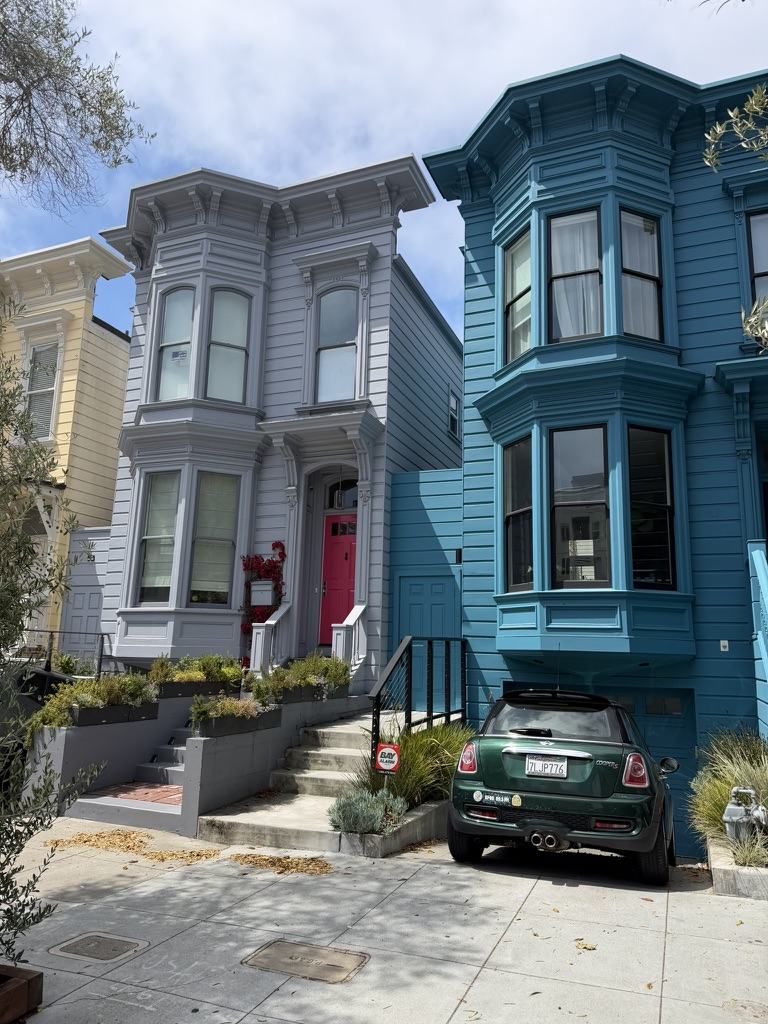
Italianate, four ways. Corinthian columns on a porch you may recognize from TV; an arcaded porch over paired red doors; a one-story cottage with a picket fence; and a pale gray classic with stacked slanted bays and a pink door. Same family, same formal posture. Photos: Kevin Ho
Vertical everything. A square bay, incised sunbursts over every window, stick trim up the corners and a gabled false front. Photo: Kevin Ho
About 1880–1900
Stick-Eastlake
The most San Francisco of them all.
Named after English designer Charles Eastlake, who wrote about furniture and reportedly hated what American builders did with his name. That didn't stop anyone.
Spot it
The square, box-shaped bay, the clearest contrast to the Italianate's angled one
Vertical lines everywhere: tall windows, stick-like trim up the corners, long skinny brackets
The ornament came mass-produced from mill catalogs, so it was affordable. That's why there are blocks and blocks of it.
Where to look Noe Valley, Eureka Valley, the Mission, the Haight, the Western Addition. If you've toured in District 5, you've walked through a lot of these.
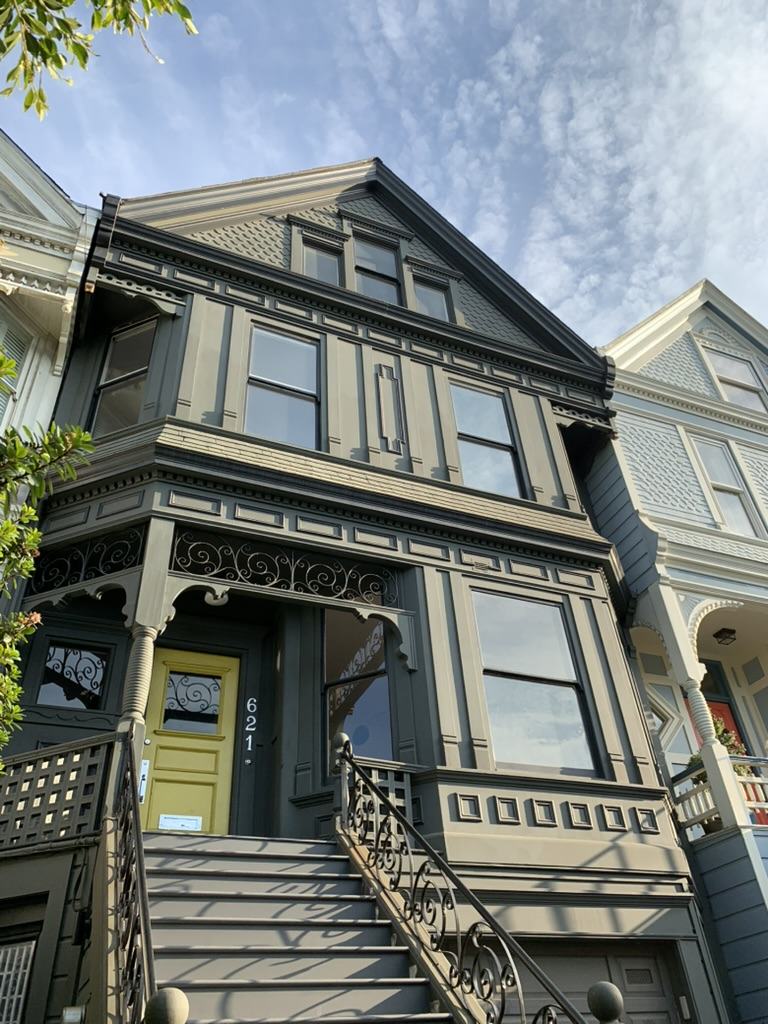
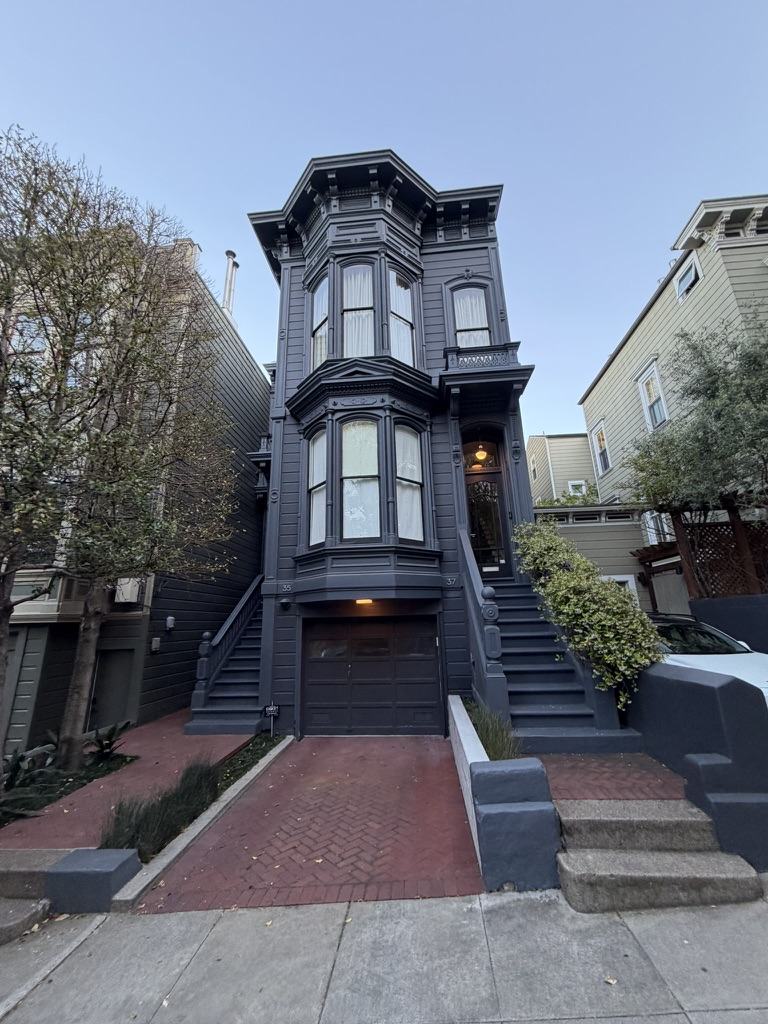
Stick-Eastlake in charcoal. Square bay, flat incised panels and stick trim everywhere, fish-scale shingles in the gable and a yellow door. Photo: Kevin Ho
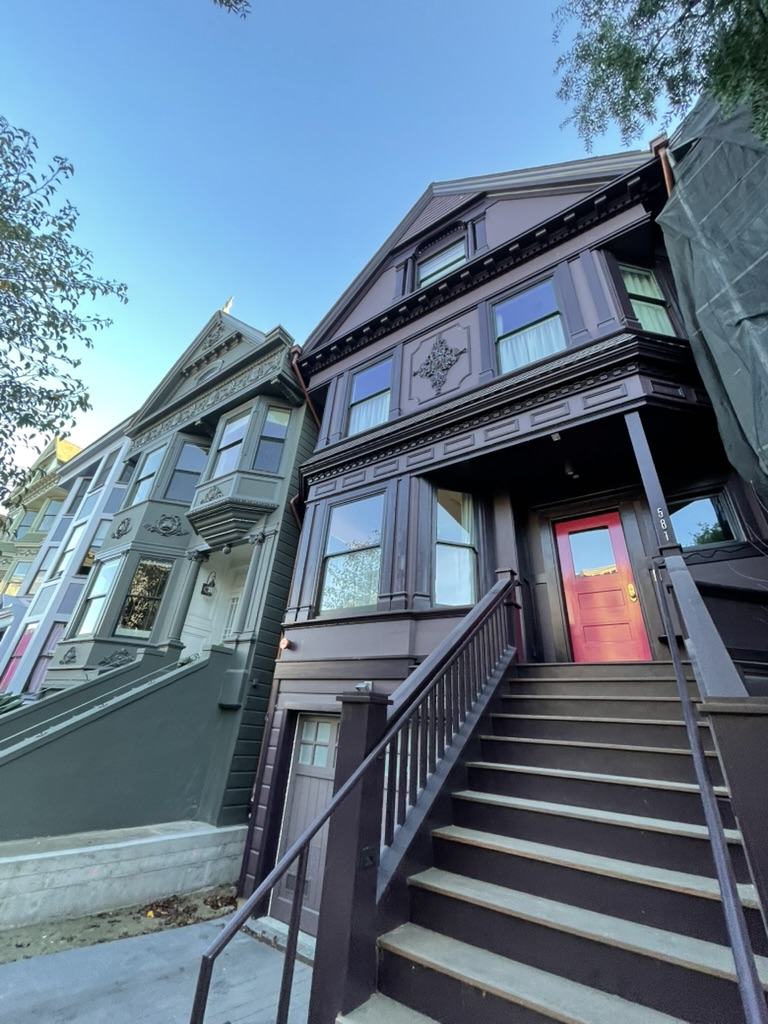
Square bays, stacked. Plum body, carved medallion, red door. Photo: Kevin HoUp close. Carved brackets, vertical boards between them. The structure is the ornament. Photo: Kevin Ho
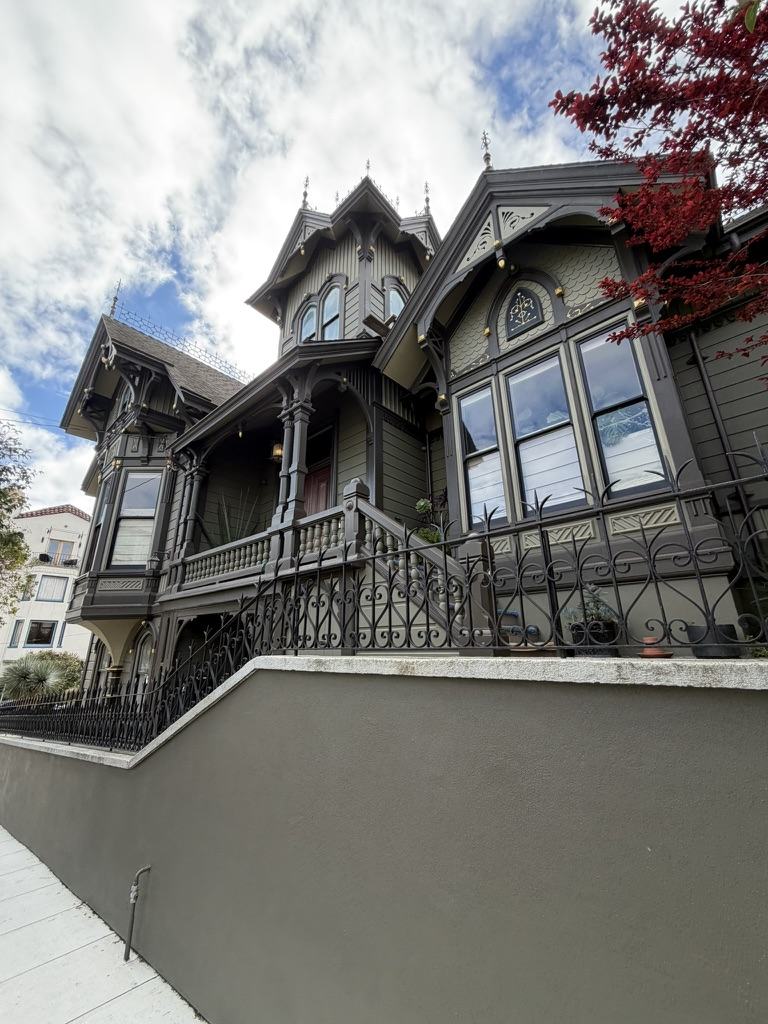
Going all out. A spired tower, finials, carved brackets, a spindled porch and a curved balcony, behind a wrought iron fence. Photo: Kevin Ho
About 1885–1906
Queen Anne
The "Scooby-Doo" house.
The most exuberant style of the bunch: hodgepodge, borrowed and adapted to each lot and each owner's budget. You can go all out, and some did. Push it a little further and it turns cartoonish, like a Disney castle.
Spot it
Steep, front-facing gables, often with fish-scale shingles and sunburst panels
Round or octagonal towers and turrets, built without power tools
Deliberate asymmetry: shingles, siding and panels mixed on one façade
Gingerbread: twists, scrolls, spindles and brackets
Towers added a little space, but mostly they got attention.
Where to look Pacific Heights, Haight-Ashbury, Alamo Square (Postcard Row is Queen Anne), Cole Valley, Duboce Triangle
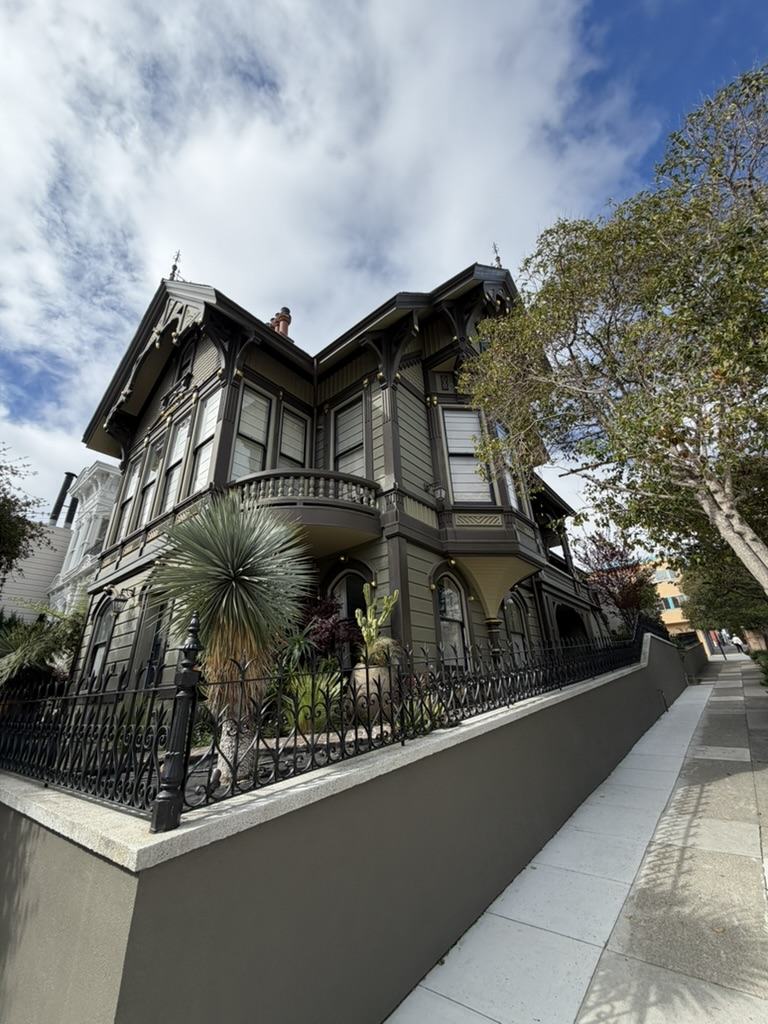
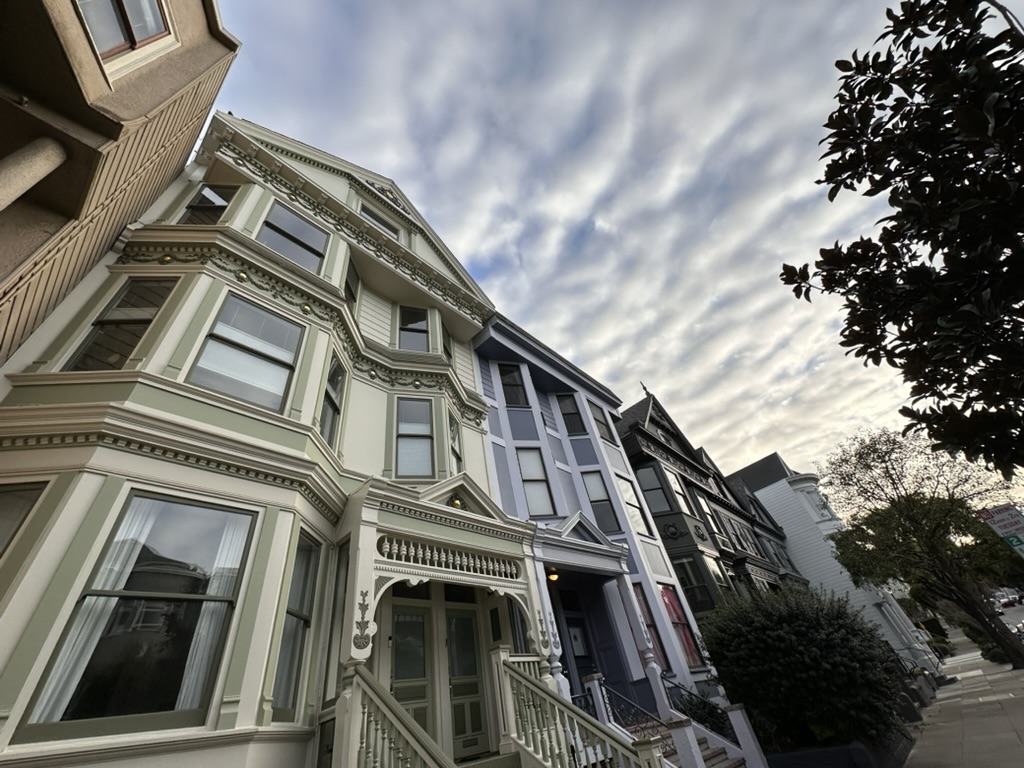
Walk around it. From the corner: a rounded balcony, bays on every side, brackets under every eave. Queen Annes are meant to be seen from more than one angle. Photo: Kevin Ho
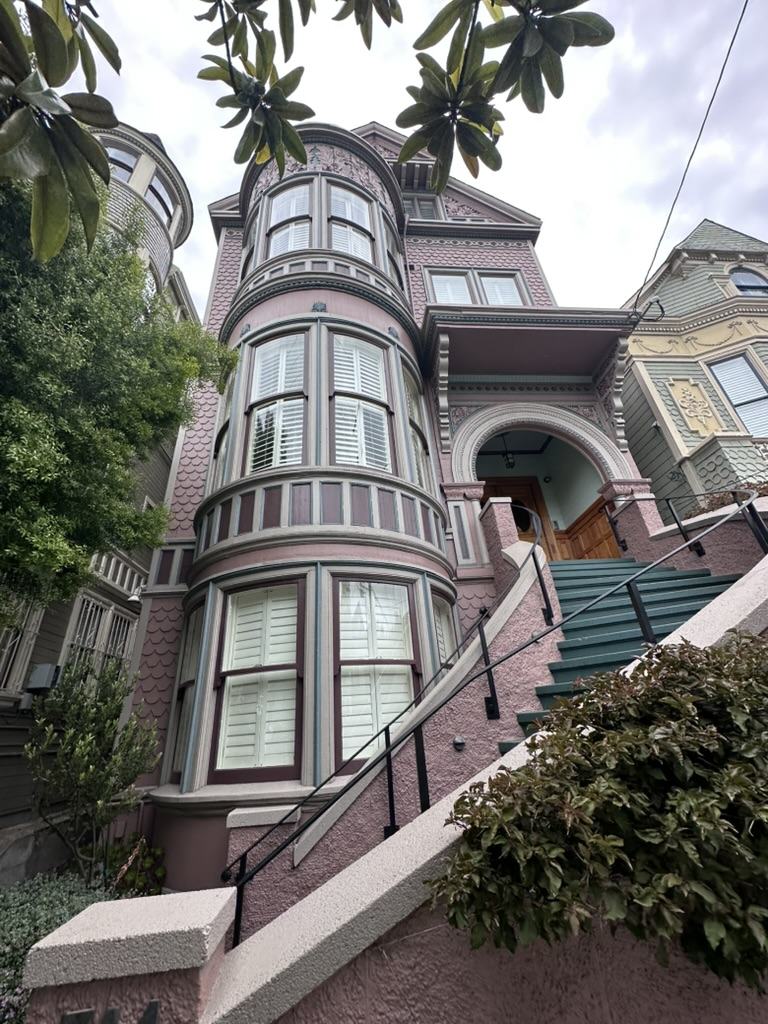
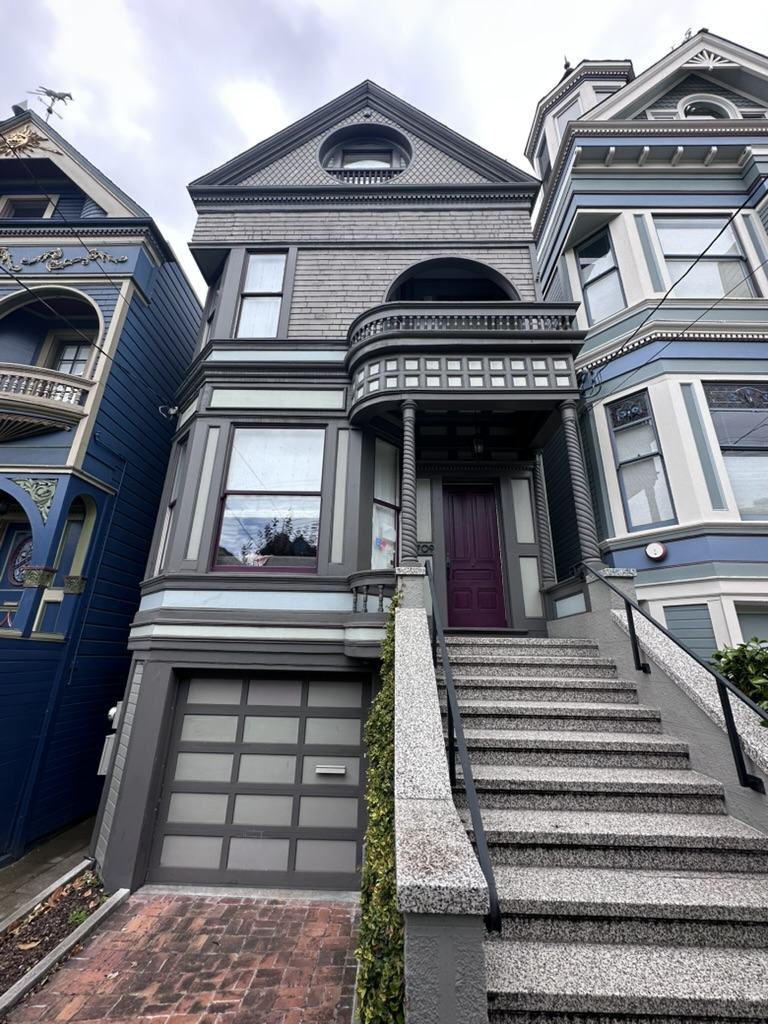
Queen Anne, three more ways. A round tower of curved glass; a shingled cottage up a stair of turned balusters; and a mint-and-cream row with carved friezes and a spindled porch. Photos: Kevin Ho
And the rare one: Gothic Revival
Very steep pointed gables, pointed-arch windows and decorative bargeboards. In the City you'll find it more often on churches than on houses. It's a curiosity, not a category you'll be touring.
A personal favorite
Going Dark: The Case for a Moody Façade
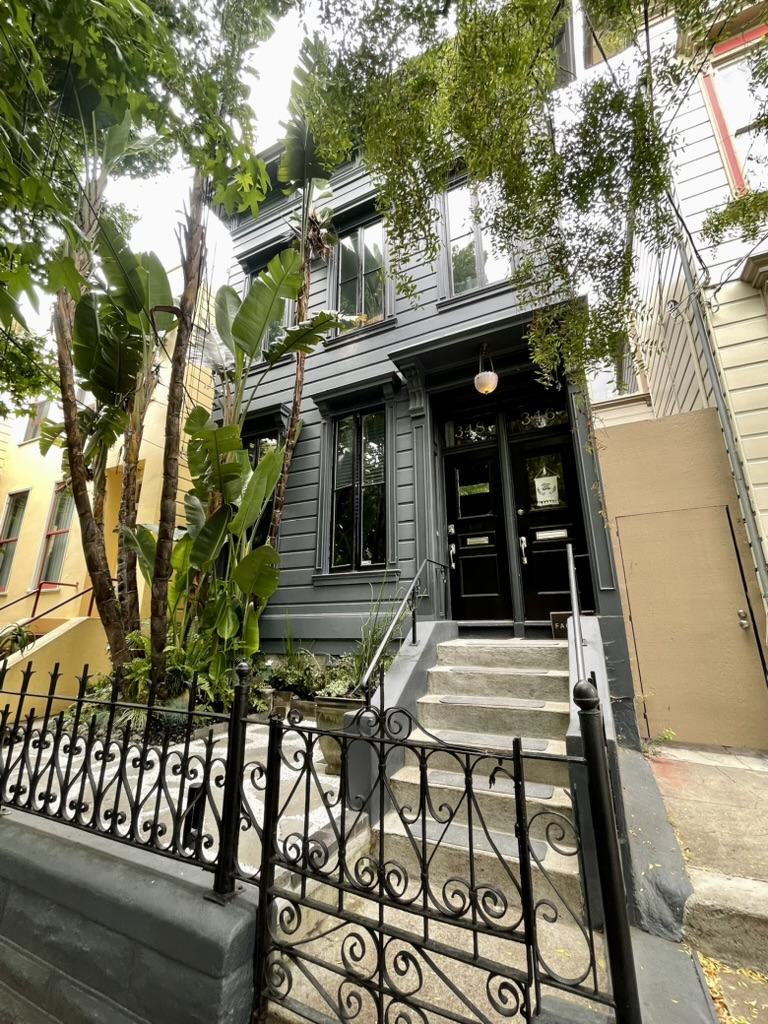
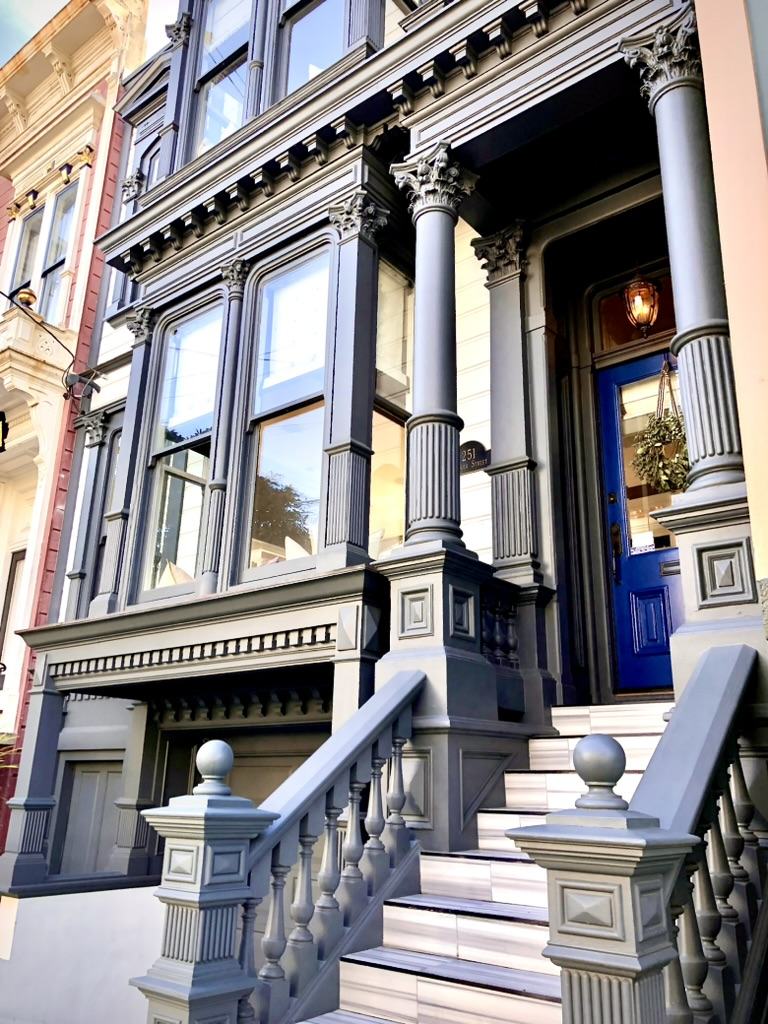
I love a dark façade. Charcoal, ink, chocolate, deep olive, oxblood. Paint a Victorian dark and something happens: the ornament stops competing with the color and starts reading as carving again, like an engraving or a pen-and-ink drawing of the house.
Shadow is the point. Brackets, dentils and window hoods throw shadows, and a dark body lets you see every one of them.
Gold leaf sings. A few gilded capitals or rosettes on a dark ground do more than a dozen bright colors.
It's very San Francisco, and very now. The colorist movement made the City famous for pastels. The dark palette is the quieter, more confident sequel, and you'll see more of it every year.
Mind the practicalities. Dark paint runs hotter in the sun, so south- and west-facing walls deserve a quality paint and good prep. Ask your painter about heat-reflective formulations, and expect touch-ups a little sooner on the sunny side.
Charcoal. Stacked slanted bays drawn like an engraving. Photo: Kevin HoInk. A porthole in the gable, twisted columns, a plum door. Photo: Kevin HoSlate. A flat front behind wrought iron. Photo: Kevin HoContrast. White columns pop against the dark body. Photo: Kevin Ho
You'll find more dark façades throughout this guide: the chocolate Italianate with gilded capitals, the olive-and-charcoal Queen Anne with the spired tower, the plum Stick-Eastlake and the charcoal one with the yellow door. Once you start noticing them, you can't stop.
Inside the box
The Typical Victorian Floor Plan
Behind almost every Victorian façade on a standard 25 x 100-foot lot sits the same plan, repeated with small variations thousands of times across the City. Speculative builders worked from pattern books, which is why, once you've walked through one, you can find your way around most of them blindfolded. This is the one I'd sketch on the back of an offer.
A typical two-story Victorian on a 25 x 100 lot. Schematic, not to scale. Room sizes are typical ranges, and every house has its own story. Drawing: Team K.Ho
Reading the plan
The side hall. The entry, stair and long hallway run down one side of the lot, and every room opens off it. It's the spine of the house.
The double parlor. The front parlor with the bay was for company; the rear parlor, through pocket doors or an arch, was for the family. Most buyers today open them up into one long living and dining room. On a lot wider than 25 feet, get ready: you may find a triple parlor.
Kitchen at the back. Originally a working room, often with a pantry. It's the room that gets reinvented, usually opened to the garden.
The "porch" laundry and bath. Indoor plumbing often came later, out back. That laundry room or rear bath was very likely an enclosed porch, which is why it can feel like an add-on, and sometimes slopes.
Upstairs. The best bedroom takes the front bay. Bedrooms line the hall, with a single bath, small closets (they didn't own many clothes) and tall ceilings with transoms over the doors for cross-ventilation.
The lightwell. A notch in the side wall that brings light and air to the middle rooms. It's charming, and it's also where leaks like to start.
Below. A raised basement, half above grade, that was often dug out later for the garage. Today it's where the expansion happens: a family room, an extra bedroom and bath, or a walkout to the garden.
Kevin's TakeWhen you tour, find the hall first. Once you know which side the stair is on, the rest of the house falls into place, and you can start asking the real questions: has the double parlor been opened up, is the kitchen still at the back, was the porch converted with permits, and what's going on downstairs? The permit history answers most of them.
Inside and out
How to Spot a Victorian, Any Flavor
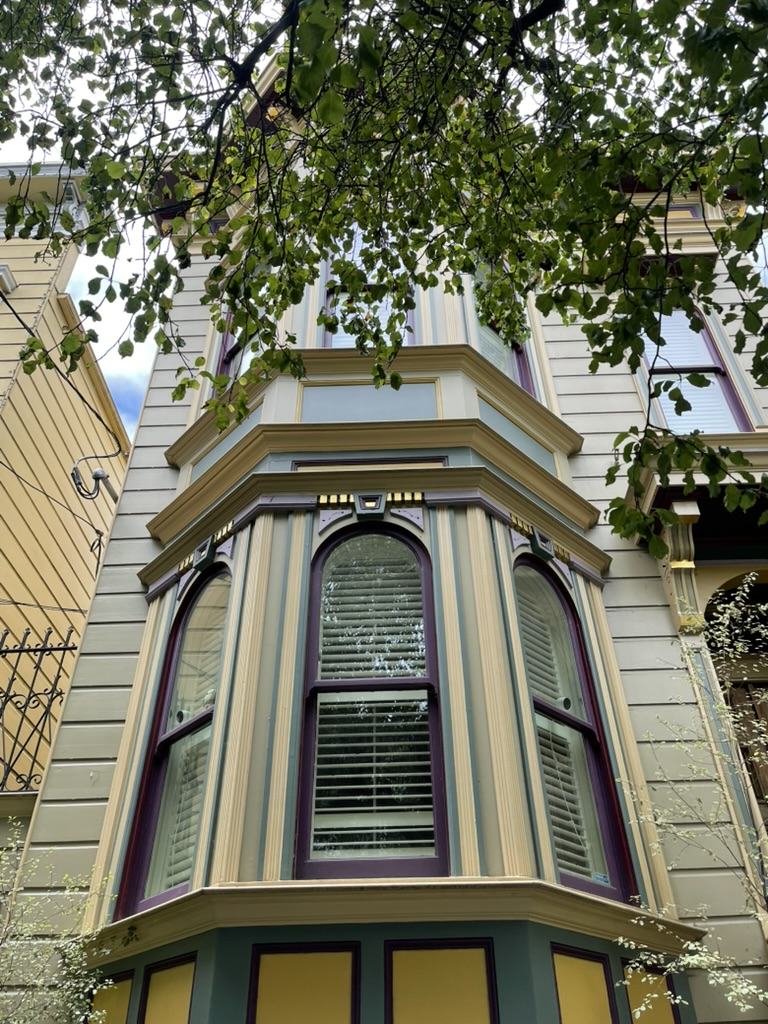
Bay windows. The near-universal calling card. Some have double bays.
Big-paned glass in wide sashes, often a big center window, with fluting on the wood frame.
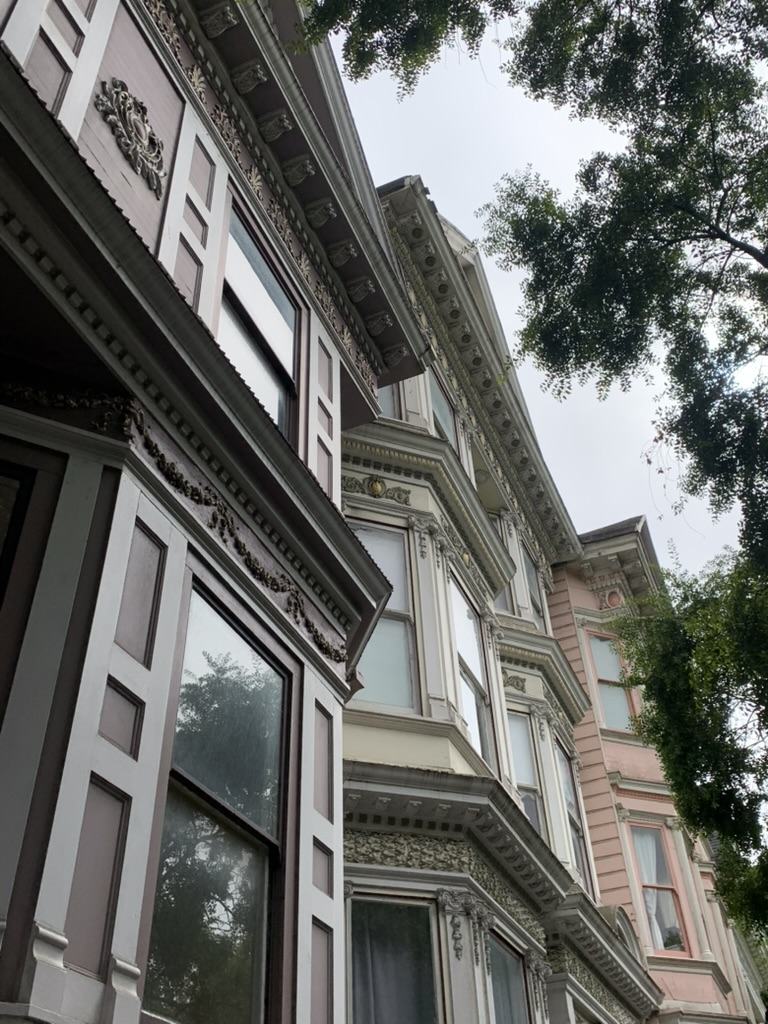
Ornate cornices of layered millwork, dentils and brackets, each layer stacked on the last.
A prominent entrance, usually up a run of front stairs.
Built in threes, or more. Speculative builders put up matching houses on standard 25-foot lots, which is why whole rows look like siblings.
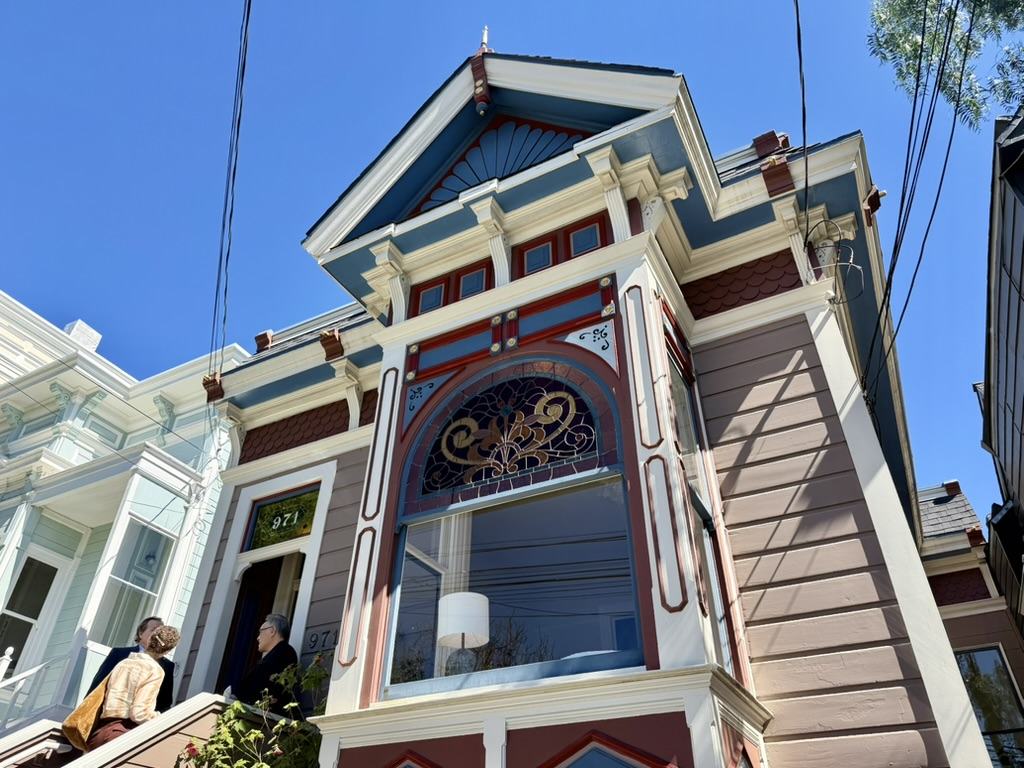
Leaded and stained glass, often in an arched transom over the big front window.
A lantern at the entrance. The originals burned gas or oil; today most are wired, but the post-mounted lamp is still a telltale.
Cornices on cornices. Brackets, dentils and plaster garlands, layer on layer down the block. Photo: Kevin HoThe slanted bay, up close. Tall arched sashes, fluted frames and a dentil cornice. Photo: Kevin HoStained glass, front and center. An arched leaded transom over the big front window, a sunburst in the gable above. Photo: Kevin HoLanterns at the stairs. Two post lamps flank the entry of this detached Italianate. Photo: Kevin Ho
Inside: the woodwork is the point
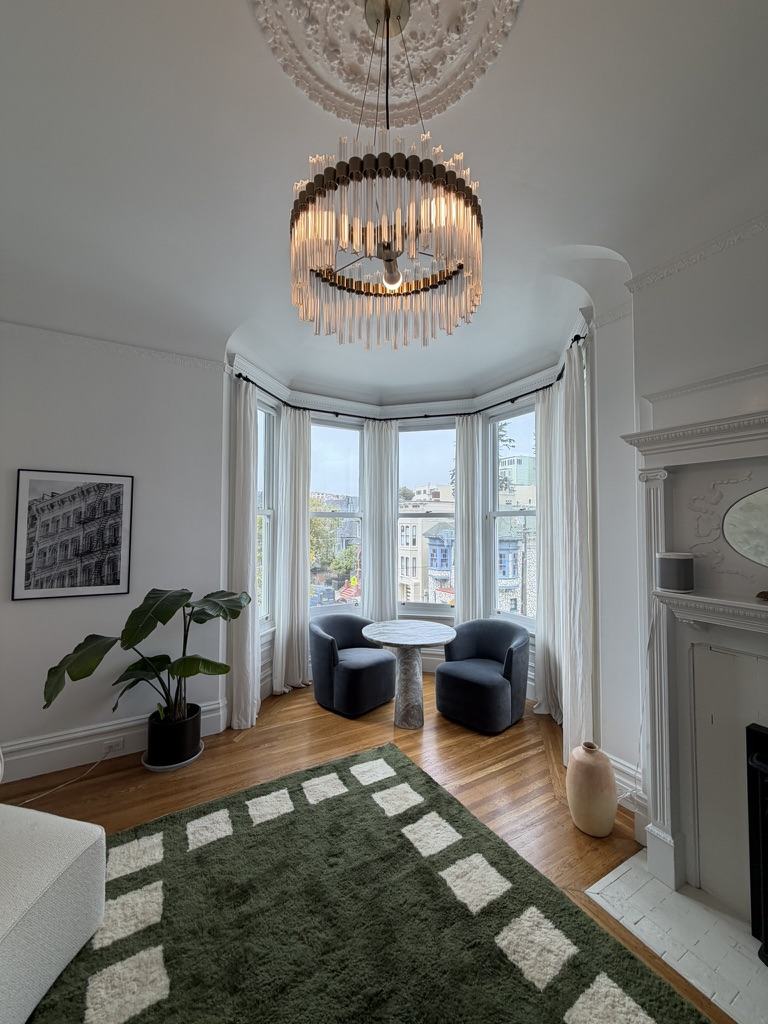
Victorians are as lavish inside as out: tall baseboards, deep molding profiles, picture rails, arches, rosettes and brackets framing each room, and a plaster ceiling rose where the gas fixture once hung. The wallpaper and Lincrusta are mostly gone, and today most walls are plain plaster.
The parlor, then and now. Plaster ceiling rose, crown molding, a carved mantel and the curve of the bay. Modern furniture, original bones. Photo: Kevin Ho
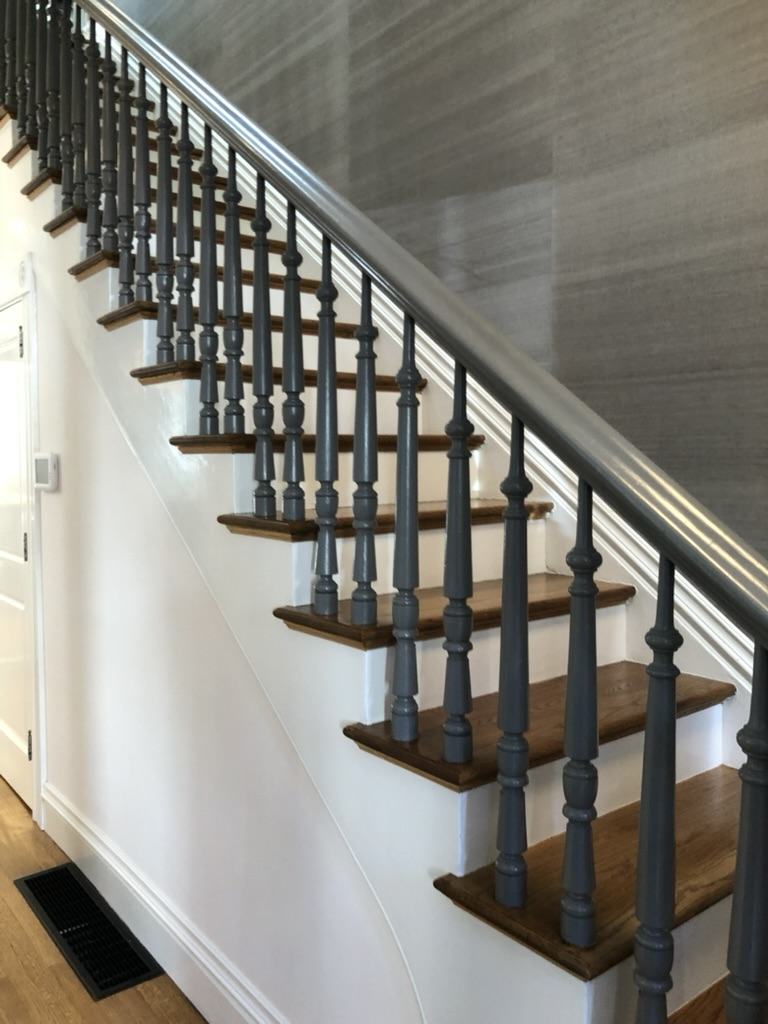
The staircase is the showpiece. Learn three words before your next open house:
Newel postThe big, fat post that anchors the bottom of the stair rail, and sometimes the landing. Often carved or paneled.
BalustersThe vertical posts that run between the stair treads and the handrail.
SpindlesThin, lathe-turned pieces that bulge out and go skinny. In Victorians the balusters were usually turned spindles. A good woodworker's lathe saw to that.
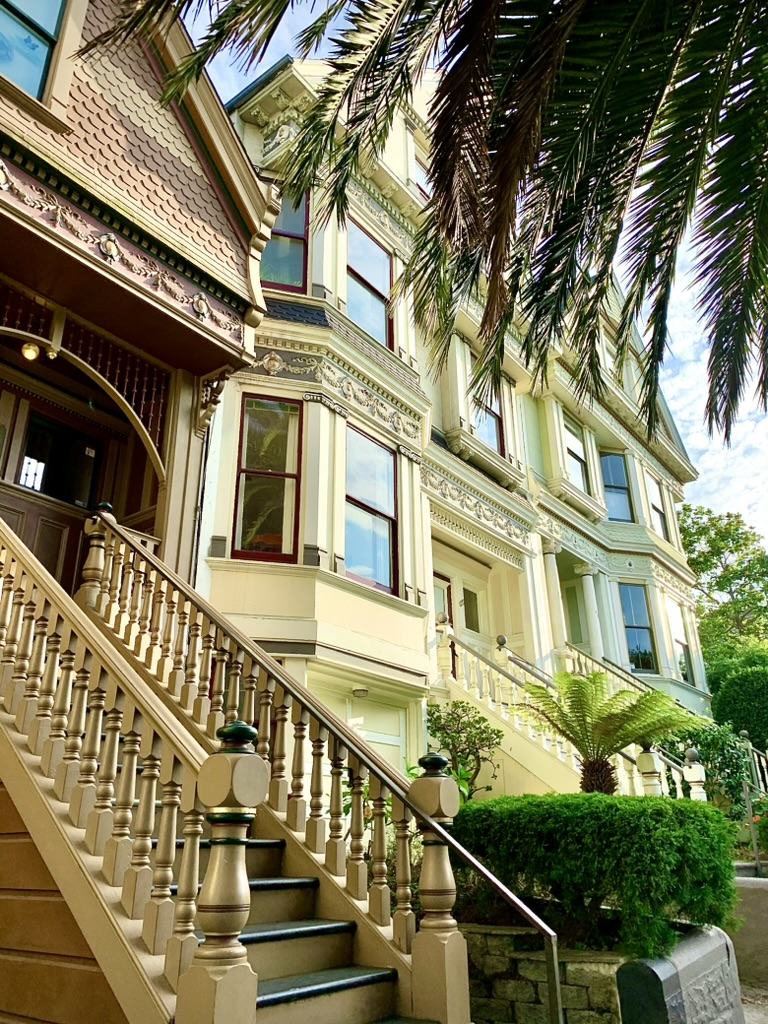
The newel post. Big, paneled, capped with a ball, anchoring the turned balusters, with Corinthian columns and a blue door above. Photo: Kevin HoBalusters and spindles. Lathe-turned, bulging and skinny, all the way up. Photo: Kevin HoOutside, too. Capped newel posts and turned balusters, one stoop after another down the row. Photo: Kevin Ho
Restoring the details
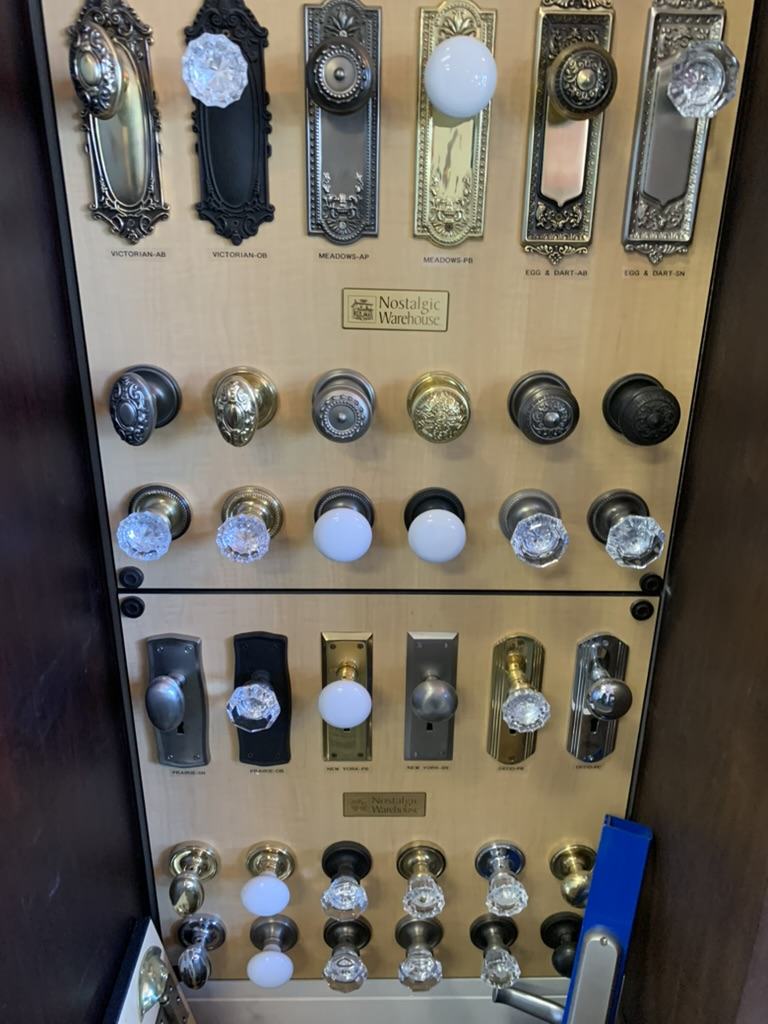
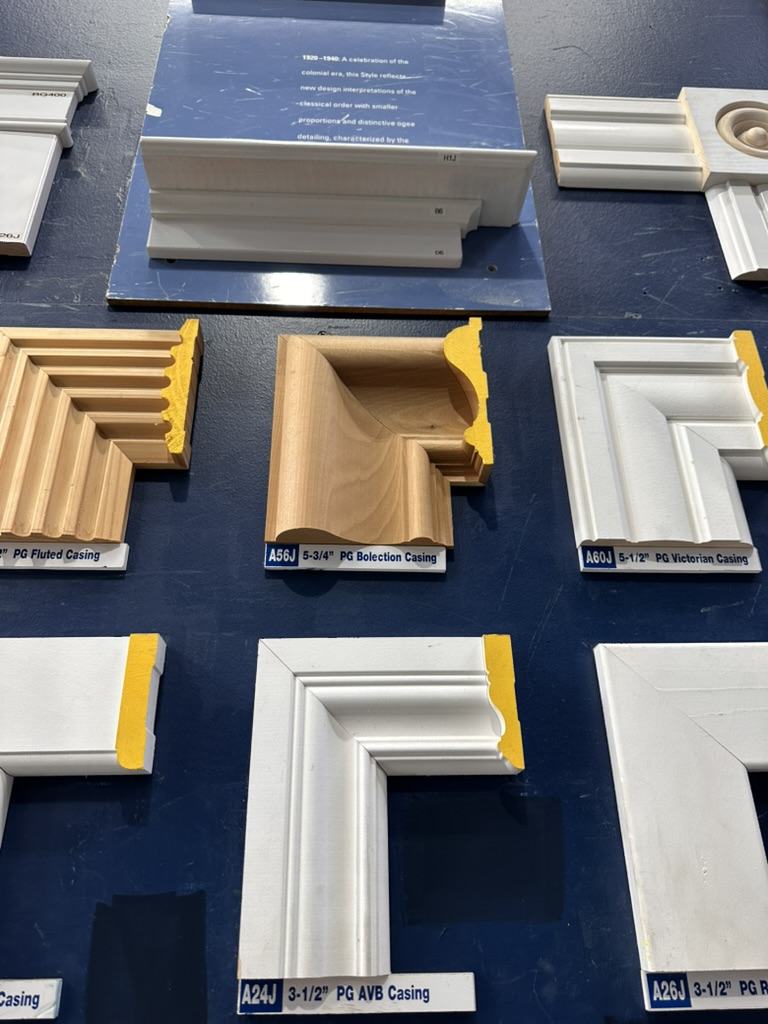
Good news if you're restoring: much of this is still made. Reproduction door sets with ornate backplates and glass or porcelain knobs, and stock casing profiles labeled "Victorian" right on the sample board, mean a missing piece rarely has to stay missing. The trick is matching the profile and finish to what's already in the house.
Where I send peopleFor Victorian door hardware (backplates, knobs, mortise locks and keys), Don's Key & Lock. For trim and millwork (casings, baseboards, crown and other moldings), Beronio Lumber. Both are in the City, and both know old San Francisco houses.
Backplates and knobs. Ornate plates with glass, porcelain and brass knobs, the hardware that finishes a Victorian door. Photo: Kevin HoCasing profiles. Fluted, bolection and Victorian casings side by side. Match the profile and a repair disappears. Photo: Kevin Ho
Buyer noteFor what to check behind the plaster (knob-and-tube, brick foundations, single-pane sash windows, lead paint, the "1900" placeholder build year), see our companion page, About Victorians.
Put on your walking shoes
The Best Blocks to See Victorians
Postcard Row gets the tour buses. These are the blocks I send people to when they want to see a whole street of Victorians, side by side, the way they were built.
District 9 · Liberty Hill
Liberty, between Valencia and Guerrero
The heart of the Liberty Street Historic District, on the National Register and a California Historical Landmark since 1983. It covers 51 houses on Liberty from Valencia up past Guerrero.
About a third are Italianates from the 1860s and '70s
Seven Stick-Eastlakes from the 1880s, six Queen Annes from the 1890s
Mostly narrow two-story homes with false fronts hiding gable roofs
It sits inside the larger Liberty Hill Landmark District, which the City designated in 1985.
District 9 · Liberty Hill
20th Street, between Valencia and Dolores
Where the 1906 fire stopped. Crews demolished houses on the north side of 20th to hold the line, so the south side kept its pre-1906 Victorians and the north side was rebuilt in the styles of the reconstruction.
One block, both eras, facing each other. It's the clearest Victorian-versus-Edwardian lesson in the City.
District 5 · Eureka Valley & Noe
21st Street, between Noe and Castro
One of my personal favorites. A block that rewards a slow walk: the bays, cornices and front stairs of one house after another, a short stroll from Castro.
District 5 · Noe Valley
Alvarado, between Noe and Castro
Another favorite, and a classic Noe Valley block of Victorians: the kind of street that explains why buyers fall for this neighborhood in the first place.
District 9 · Inner Mission
Lexington and San Carlos
Bonus round, a few blocks from Liberty. These two narrow streets are lined with Italianate row houses built 1875–1877 by The Real Estate Associates, the speculative builder that put up whole rows at once.
District 6 · Alamo Square
Steiner, across from Alamo Square
Yes, it's on every postcard, and it's still worth it. Walk the full square, not just the famous row. The surrounding blocks are packed with Queen Annes, Italianates and a few grand corner houses. More on Postcard Row.
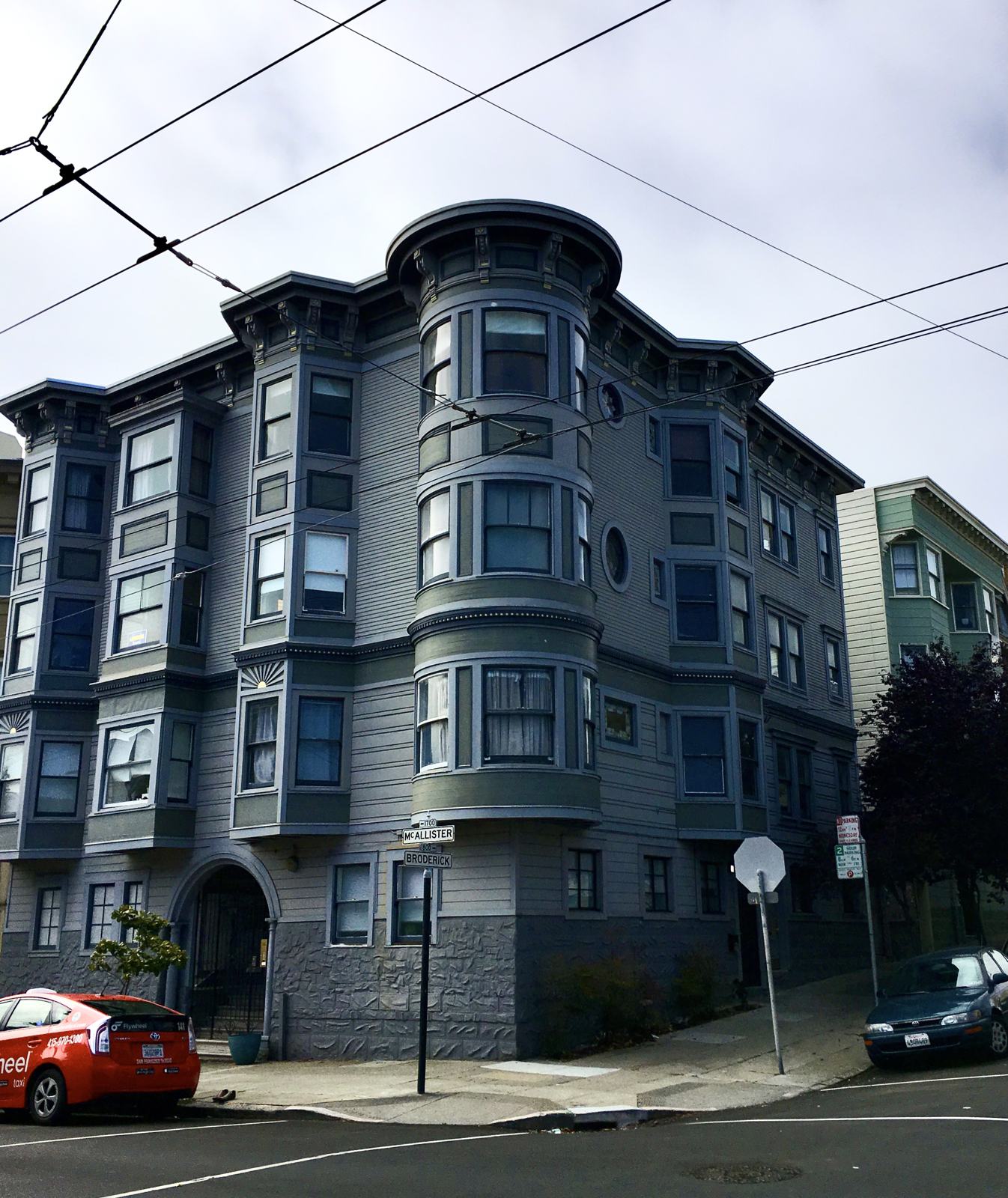
The rounded, stacked bay. An Edwardian flats building on a corner: a round bay rising three floors, square bays down the side, a deep bracketed cornice. Photo: Kevin Ho
About 1901–1915
Edwardians: Victorian, With the Volume Turned Down
Edwardian refers to the reign of King Edward VII (1901–1910). In the City, people stretch it to roughly World War I, and it really means the rebuilding after 1906. That's why Edwardians fill the areas the fire burned, from the Inner Mission and South of Market to the Tenderloin, Russian Hill and North Beach, and infill Victorian blocks everywhere else.
Flat roof with a deep bracketed cornice; usually no towers or steep gables
Rounded or squared bays, stacked straight up two or three stories
Inside: fewer, larger rooms, wider halls, more light, box-beam ceilings, built-in buffets, and the first real closets
Stacked flats are the big one for buyers. The two- and three-unit Edwardian flats building, one full-floor flat per level, is everywhere in Districts 5, 6, 7 and 9, and a lot of them are now TICs or condos. If you've toured a "classic two-unit Edwardian" in Noe or the Mission, this is it.
Kevin's TakePlenty of what people call a Victorian is actually an Edwardian, and that's fine. Edwardian layouts often live better today: more light, bigger rooms, fewer chopped-up parlors. The systems questions are similar, just a couple of decades younger.
About 1880–1930
Arts and Crafts: Handmade, on Purpose
The Arts and Crafts movement was a reaction to the Victorian era. Of course, these things go in waves, right? After decades of ever-more ornament, the pendulum swung back.
What you notice first is what isn't there. The façades are much plainer: no gingerbread, no towers, no layered cornices. Look closer and you can tell the craftspeople really took their time with wood and other materials: joinery you can see, exposed rafter tails, hand-finished paneling, built-ins made for that exact room. Some would call it a more honest architecture.
Where a Victorian shows off, an Arts and Crafts house shows its work.
In the City you'll see them largely in the Richmond and Cole Valley, with more scattered through the west and south sides. In the Bay Area the style took two main forms.
Shingles and steep gables. Natural materials, little applied ornament. Photo: Kevin HoThe bungalow. Low roof, deep porch, one easy level. Photo: Kevin Ho
First Bay Tradition (about 1880–1920)
Unpainted redwood shingles, natural wood interiors, houses that sit into their hillsides.
Architects included Bernard Maybeck, Willis Polk, Ernest Coxhead and later Julia Morgan.
Where to look: the Russian Hill summit, Presidio Heights and pockets of Pacific Heights. The Swedenborgian Church (1895) at Lyon and Washington is the textbook example.
Craftsman bungalow (about 1906–1930)
Low-slung roof, deep overhanging eaves, exposed rafter tails and brackets.
Front porch on tapered square columns, set on stone, clinker-brick or concrete piers.
Multi-pane upper sashes over a single pane, grouped in bands.
Inside: built-in bookcases and buffets, box-beam ceilings, paneling, and a fireplace that anchors the living room.
Where to look: the Richmond, Cole Valley, Ingleside Terrace, Westwood Park, Bernal Heights, the Excelsior, and post-fire infill in the Mission.
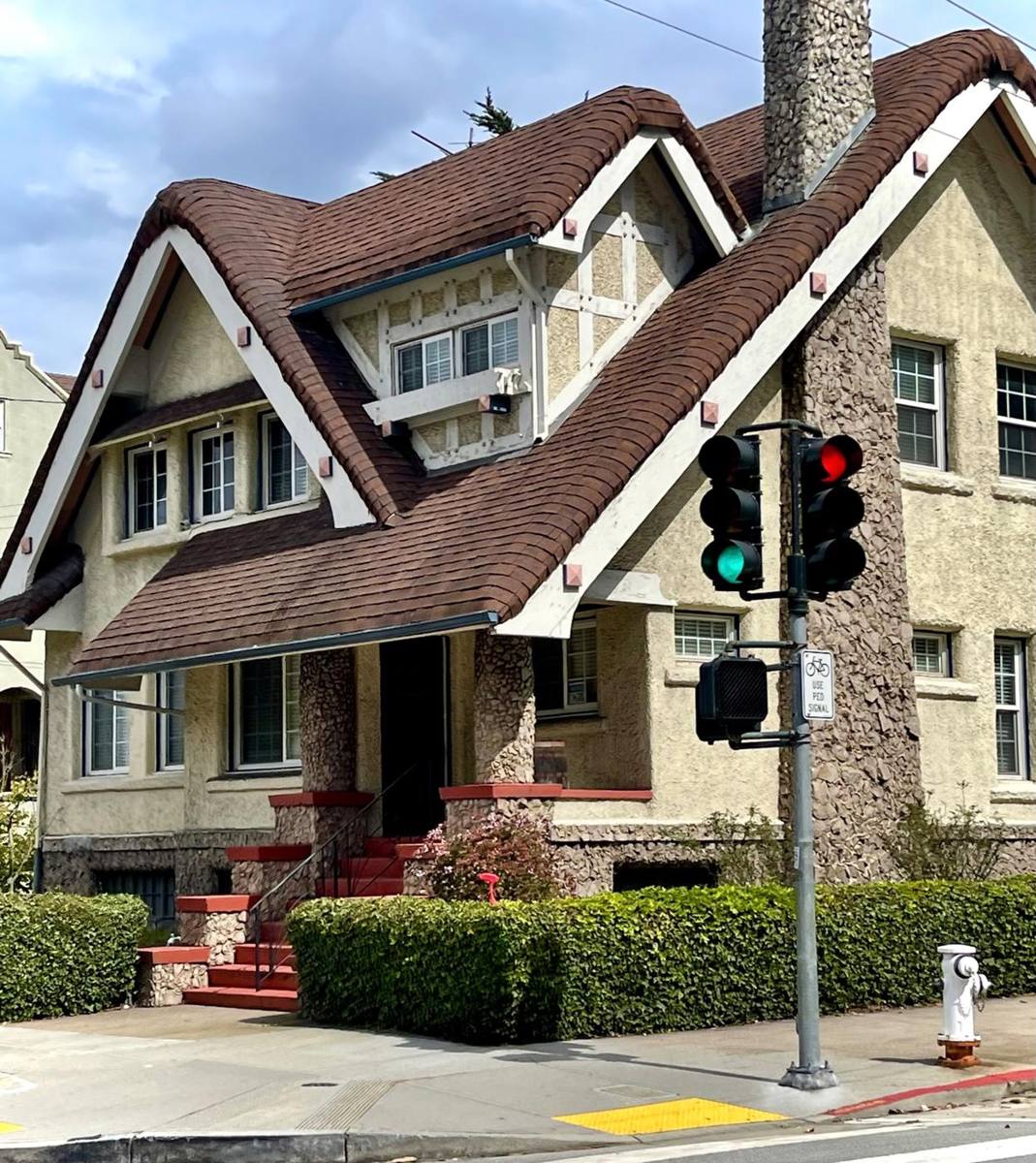
Arts and Crafts with a storybook accent. Sweeping roofline, half-timbering, and a stone chimney anchoring the corner. Photo: Kevin Ho
Kevin's TakeCraftsman houses here are often smaller and single-level, with less of the stair-climbing that comes with a Victorian. That makes them a quiet favorite for buyers who want character without a three-story walkup. Supply is thin, so a good one rarely lasts long.
Save this one
Tell Them Apart in 10 Seconds
Look at the roof, then the bay. That's usually enough.
Italianate
1865–1885
Roof
Flat, false front, heavy brackets
Bay
Slanted
Tell
Formal, hooded windows
Stick-Eastlake
1880–1900
Roof
Flat or low gable
Bay
Square
Tell
Vertical sticks, incised sunbursts
Queen Anne
1885–1906
Roof
Steep gables, towers
Bay
Round, square or turret
Tell
Gingerbread, fish-scale, asymmetry
Edwardian
1901–~1915
Roof
Flat, deep cornice
Bay
Rounded or squared, stacked
Tell
Classical garlands, restraint
Craftsman
1906–1930
Roof
Low, deep eaves
Bay
Rare
Tell
Exposed rafters, porch piers, built-ins
Flip through
The Photo Album
Every photo in this guide, in one place. Use the arrows, swipe, or tap a thumbnail. Tap any photo on the page to open it here, too.
Questions we hear on tour
FAQ
How many Victorian homes are in San Francisco?
Estimates run from about 10,000 to 14,000 surviving Victorians, out of roughly 48,000 Victorian and Edwardian houses built between 1849 and 1915. There's no official count.
Where are the most photographed homes in the City?
The Painted Ladies of Postcard Row, 710–720 Steiner, across from Alamo Square. Developer Matthew Kavanaugh built them between 1892 and 1896.
What is a Painted Lady?
Any Victorian or Edwardian painted in three or more colors that bring out the detail. Postcard Row is the famous one, but you'll find Painted Ladies all over the City.
What's the difference between a Victorian and an Edwardian?
Timing and restraint. Victorians (pre-1906) are more ornate, with steep gables, towers and gingerbread. Edwardians (about 1901–1915) are calmer and classical, often flat-roofed flats buildings with bigger, brighter rooms.
Is it harder to buy a Victorian?
It's not harder, just different. Expect older systems, possible foundation work, and Planning rules on street-facing windows and façades. A good pre-offer inspection and a look at the permit history tell you what you're getting. Every house is its own story.