
SOUND OFF · JULY 19, 2026 · KEVIN HO, VANGUARD PROPERTIES

THE LAST TWO DIGITS ARE A MESSAGE

List prices are officially a seller decision, but a lot of agent advice is at play. Part science, part art, a list price is a signal to buyers from sellers. In the City, the signal is more please.

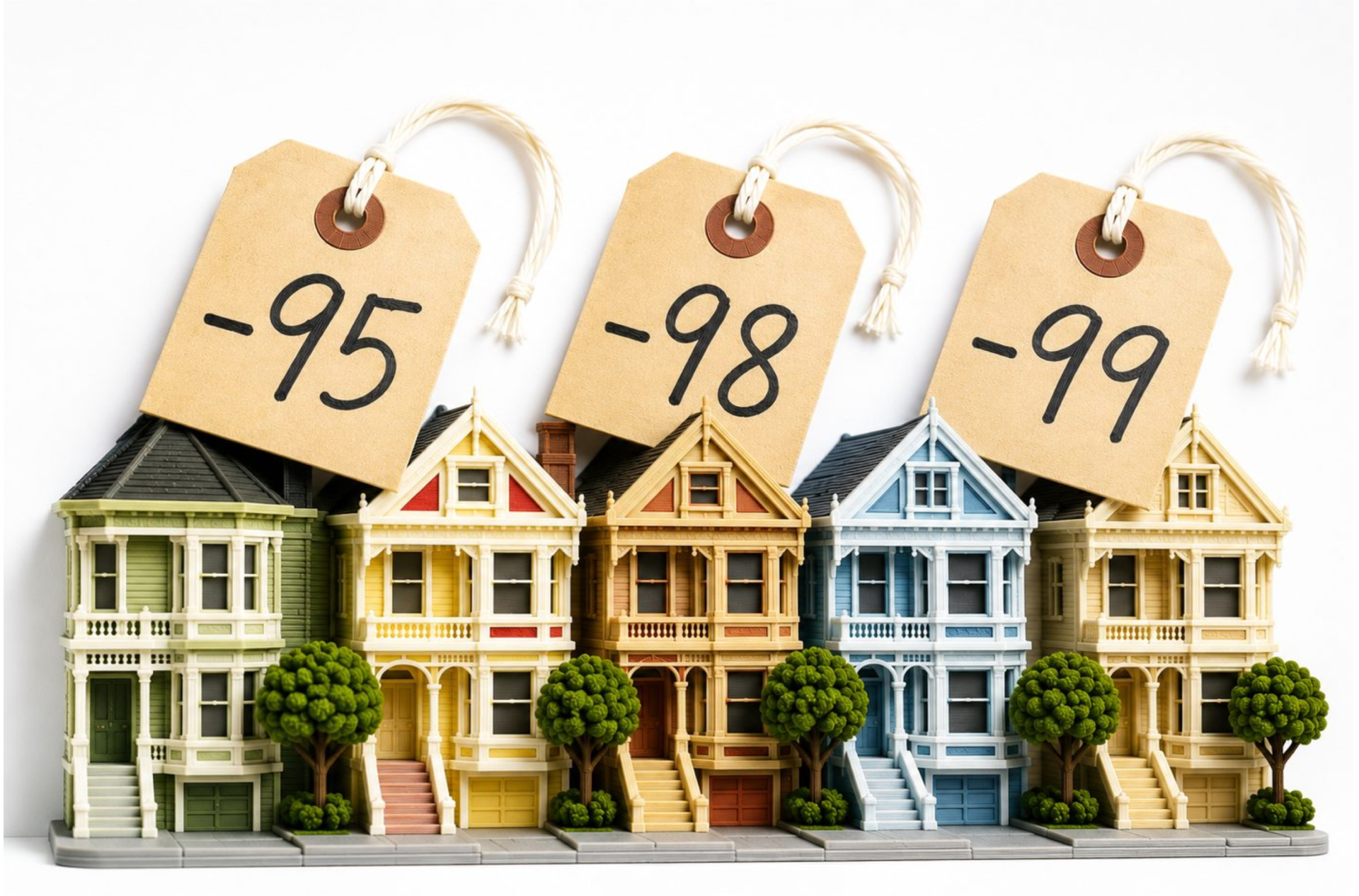
Three tags, half the market
4,152
Closed sales studied
65.1%
Sold over list
55.5%
Listed at −95, −99 or −98
96.1%
Priced in whole thousands
What a list price actually says

The Signal

  • The seller has no intention of accepting list. More than 65% of sold homes in the City sell well above list — 65.1%, against 9.9% at list and 24.9% below.
  • The last two significant digits will likely be −95, −99 or −98. Across the 4,152 closed sales since September 2025, those three endings were used more than half the time — 35%, 13% and 7.5% respectively.
  • A −95 catches buyers who'd otherwise never look. If the goal is $2.4M+, list at $1.995M and everyone with a $2M ceiling may now stretch.
  • Bidding-war agents just price at $995,000 no matter what. It is a strategy, not an appraisal.
How often the City uses each list-price ending The minus 95 ending appears on 35.3 percent of list prices, minus 99 on 12.8 percent, and minus 98 on 7.5 percent. HOW OFTEN THE CITY USES EACH ENDING 10% 25% 40% -95 35.3% -99 12.8% -98 7.5%

The heavier the convention, the lower it hangs. Together these three endings carry 55.5% of every list price in the City. A further 6.3% land on a clean round number, and 8.9% sit on a −50.

Why −95 works
$1,995,000
List Price
$2,400,000+
The Actual Goal

A five-thousand-dollar haircut moves a house from one search bracket into another. Every buyer with a $2M ceiling now sees it — and once they're standing in the living room on a Sunday, the ceiling has a way of moving. That is the whole trick, and it is not a secret. It is simply the most reliable one available.

The signal is not the outcome

None of it survives
the offer date

The endings that dominate list prices very nearly vanish from selling prices. −95, −99 and −98 account for 55.5% of what sellers ask and 6.7% of what buyers pay. Buyers don't price to psychology — they price to whatever it takes to win, and the numbers scatter toward −25, −75 and −15 accordingly.

The discipline that does hold is the rounding. 94.7% of selling prices still land on whole thousands. The City clears in round numbers even when it stops clearing in tidy ones.

Never blend them

A house is priced at 95.
A condo is priced at 99.

Single-Family  ·  1,858 Sales
Listed at −95 42.1%
Listed at −99 9.4%
Sold over list 83.8%
Median over list $382,000
Condominium  ·  1,955 Sales
Listed at −95 29.2%
Listed at −99 15.5%
Sold over list 49.4%
Median over list $116,000

The City's fourth ending

−88 is a different conversation

Behind the big three sits a convention nobody else's market really has. 183 listings — 4.4% — ended in 88, and they cluster. Eight is auspicious in Chinese culture, and these are the neighborhoods with the City's largest Chinese-American homeowner populations.

It is a house convention (6.4% of single-family, 2.9% of condos) and an entry-tier one — above $3M it essentially switches off, one listing in 251. And it is not one team's habit: 149 different agents wrote those 183 listings. The same numbers keep recurring — $1,188,000, $1,288,000, $1,388,000, $988,000.

Worth knowing: −88 houses drew multiple offers more often than −95 houses (93.3% vs 89.3%) but produced half the over-list dollars — a $236,112 median against $475,000. An 88 tends to be an honest number aimed at a specific buyer. A 95 is built to run an auction.

Share of sales listed at −88

  • 94134 Portola 17.2%
  • 94132 Lakeside 10.0%
  • 94116 Parkside 9.3%
  • 94112 Excelsior 9.2%
  • 94124 Bayview 8.7%
  • 94122 Outer Sunset 7.1%
  • 94131 Noe / Glen Park 4.6%
  • 94107 Potrero 4.2%
  • 94127 West Portal 3.2%

Thirteen points separate the two, and I read that as strategy rather than habit. A house listed at −95 is usually a number the seller has no intention of accepting. A condo listed at −99 is closer to a number someone actually hopes to get. Different tools, different jobs — and the results follow: houses clear over list five times in six, condos barely half the time.

Tenancies-in-common sit in between at 59.2% over list and a $105,000 median. They also keep the strictest rounding in the City: 98.9% of TIC list prices end in three zeros.

What I actually do

How I price a listing

  1. Start with comparable sales. They are the floor of the conversation, not the answer to it.
  2. Correct for the fact that comps lag. Because they are lagging indicators, I ask other active agents for their read on what is happening right now, this week, in this pocket.
  3. Then draw on years of intuition and experience. The goal is being just the right amount of enticing while staying a bit mysterious — just how much under? — but only just so, as this art demands.

Every circumstance is different, and the tables above are a map, not a verdict. A −95 that runs an auction on 24th Street can sit for six weeks in a high-rise. What the data is good for is knowing which convention you are choosing, and why — rather than reaching for one because it's what everybody reaches for.

Kevin K. Ho

Vanguard Properties  ·  Team K.Ho

kevin@team-kho.com   |   team-kho.com

415.297.7462

DRE #01875957

About the numbers. Figures drawn from the San Francisco MLS, covering all 4,152 residential sales that closed in the City between September 2, 2025 and July 7, 2026, across all 10 districts. Single-family homes, condominiums and TICs are reported separately and never blended; over-list figures are stated in dollars. "Last two significant digits" means the pair immediately left of the trailing zeros — $1,495,000 reads as a −95. Neighborhood labels reflect the ZIP codes carried in the export. Every property and every seller is different; none of this is a prediction about yours.